Category Archives: Places to eat

Frankel’s Delicatessen & Appetizing

The #3 specialty combo from Frankel's Delicatessen

[Edit: As of late 2017, Baz Bagel—the bakery that makes the bagels used at Frankel’s—no longer has a nut-free kitchen. The gluten-free bagels at Baz are now made with almond flour, and since they’re made in the same kitchen (and on the same equipment) as the regular bagels, I’m no longer on board. So that…slims the pickings at Frankel’s quite a bit, doesn’t it?]

My dad is notoriously terrible at handling my allergies. He’s convinced he can determine with a glance whether a pastry contains nuts, and he has a habit of insisting that restaurants are nut-free based on nothing more than his own intuition. It’d be one thing if he had some sort of inexplicably high success rate with these things, but he doesn’t, so I’ve learned to ignore his suggestions—or at least to be sure to thoroughly vet them myself.

That said, he was onto something when he suggested Frankel’s, a Greenpoint delicatessen that opened this past spring. The folks at Frankel’s—the Frankel brothers, rather—don’t cook with nuts, meaning there are no nuts or nut products in their kitchen. Their pastries are supplied by Green’s and their bagels by Baz; plus, they sell Utz and Zapp’s chips, which are both made in a nut-free facility. Knowing all that, one might start to get the idea that Frankel’s is intentionally nut-free—but it isn’t, as far as I know. [Edit: Actually, it is. See the edit below.]

Their rye bread (supplied by Rockland Bakerydoes come with a “may contain” warning, but the matter isn’t so simple. I’ve actually been told by Rockland’s Food Safety Manager that the rye is made in a nut-free facility—but I can’t be sure, as the information I’ve gotten from Rockland has been inconsistent, to say the least. Katz’s Delicatessen uses Rockland’s rye, too—so rather than re-spieling, I’ll just direct you to the first few paragraphs of my post on Katz’s.

I’ve eaten Rockland’s rye at Katz’s and at Frankel’s countless times without issue, but that doesn’t necessarily mean you should follow my lead. Use your own discretion, obviously—and if you aren’t comfortable with Frankel’s rye, the good news is that it’s easy enough to avoid, as you can order pretty much anything you want on a bagel. (As bread goes, Frankel’s also offers rolls and challah, but both are supplied by Amy’s Bread, which is not an allergy-friendly company, so I’ll just stick to recommending the bagels—and maybe the rye, depending on whom at Rockland you trust).

And while I’m ironing out allergen information, I should probably mention that Frankel’s gets their fish from Acme Smoked Fish (who don’t use have any nuts in their New York facility), and that they get some of their meats from a nearby warehouse that they don’t seem to want to name. It doesn’t seem as though they do all that much in house, which costs them a few points on the allergy-friendliness scale—but really, whaddya gonna do? I’ve eaten at Frankel’s without issue quite a few times now, and I feel it’s worth a post, at the very least. Your standards may differ, and that’s fine. This is my blog, after all.

[Edit: A week or two after publishing this post, I received an email from someone who identified herself as a part of the Frankel’s team, saying that Frankel’s is, indeed, intentionally nut-free. Evidently, their executive chef, Ashley Berman, is allergic to peanuts—and while she isn’t allergic to tree nuts, the folks at Frankel’s evidently do their best to maintain an environment that’s 100% nut-free. (Apparently, Berman has worked with Amy’s Bread for years, and she’s comfortable with their handling of allergens. When it comes to breads, though, peanuts are certainly much easier to avoid than tree nuts—so do with that information what you will.) Good news nonetheless, though. I had a feeling something was up!]

Pastrami, egg, and cheese on a plain bagel from Frankel's Delicatessen

You know, for a Food Allergy Blogger™, I have an unusual amount of hatred for blogging about food allergies. Spelling out allergen information isn’t any fun; I much prefer eating and/or talking—writing—about eating. Onto the fun part, then.

The menu at Frankel’s is small and simple, but that doesn’t make it any easier to decide on what to order. I’m not the biggest fan of Baz’s bagels—I wrote some nice things about them back in June, but I’ve since come out of my bagel-deprived stupor and realized that theirs are rather underwhelming, to say the least—but the idea of a Frankel’s bagel sandwich had me drooling nonetheless. (Perhaps a Baz bagel would fare better out of Baz’s hands. That was my hope, at least.) Why stop at bagels, though? Frankel’s has all the classic sandwiches—pastrami, corned beef, Reubens, roast turkey, salami, chopped liver, and brisket—as well as breakfast sandwiches, hot dogs, and latkes. How was I ever supposed to make up my mind?

The first time I went, I ordered a #2 specialty combo (Nova lox, Nova spread, and salmon roe on a bagel), and to be honest, I wasn’t impressed. It wasn’t bad, but it was no different than anything I could’ve gotten at Baz, which isn’t exactly a compliment. The lox was fine, but the salmon roe wasn’t the best, nor was there very much of it—and the sandwich was made with regular cream cheese rather than Nova spread. Oops.

There was no way in hell I was giving up that quickly, though. Far sooner than I’d like to admit, I returned to Frankel’s with Sam in tow, and that time, I was able to sample a little more widely. We split two sandwiches: the #3 specialty combo (Irish organic salmon, whitefish salad, capers, onion, tomato), and the pastrami, egg, and cheese.

Now, the #3 (pictured at the top of this post) was good, but it didn’t exactly leave me wishing for another. Perhaps it would’ve, though, if the ever-important bagel itself had been good, because the whitefish salad was perfect, the onion was cut into super-thin slices that actually made sense in the context of the sandwich (for some reason, this is rare), and the tomato was fresh and flavorful. The bagel itself really left me wanting, though. Baz’s aren’t the slightest bit fluffy, and for some reason, they never taste all that fresh. It’s a shame, because the #3 was otherwise solid.

The pastrami, egg, and cheese (pictured second above, in Sam’s clutches) is another story, though. That thing never fails to make my day, no matter how many times I order it. The egg—which is actually good on its own, unlike that you’ll find in your average bodega sandwich—is absolutely smothered with melted cheese, and the pastrami is peppery, fatty, and tender as can be. The sandwich as a whole is the very definition of “melt in your mouth,” and its contents are so good that they actually manage to make up for that boring-ass Baz bagel. Seriously: Forget about bacon. Pastrami is definitely the superior meat.

frankels

The pastrami, egg, and cheese may be my favorite Frankel’s offering—if we aren’t counting their specials, that is. If we are, though, I might have to go with the heirloom tomato ordeal I had a few weeks ago (immediately above, in an iPhone photo, as I was without my camera that day). It was simple—an open-face bagel topped with tomato, basil, chives, olive oil, and just enough cream cheese—but it was surprisingly tasty.

The tomato, thick cut and actually flavorful, was one of those magnificent treasure-tomatoes you’ll only find at the farmers’ market, and the olive oil, while nothing special in itself, brought the whole creation together wonderfully. God, it was good. I wish it weren’t just a special—but I also don’t, because out-of-season tomatoes suck. (Take note, Baz.)

But don’t get me wrong: I like their simpler sandwiches, too—they just don’t excite me as much as the ones I mentioned above. The brisket (pictured below—on rye, though it usually comes on Amy’s challah) is actually made in house with Grandma Frankel’s recipe in mind, and it’s really goddamn tasty, if a bit too sweet. Plus, the bread comes griddled, which originally went a very long way in winning me over. And though the sandwich as a whole is a little one-note, it certainly makes for a satisfying meal.

IMG_5612

The pastrami and corned beef—while certainly nowhere near as good as anything you’ll find at Katz’s—are decent, too, though I’m not sure I’d order either again. On its own, the pastrami’s on the bland side. What flavor it does have is a bit too hot-doggy for me, but it’s thick-cut, fatty, and, um…present in large quantities, so there’s only so much complaining I can do. The corned beef’s a little worse, though; it just comes off as a fattier version of ham, without anywhere near enough of that signature corned beef tang. Oh well.

Anyway, Frankel’s is a neat little place…despite the fact that they don’t seem to do much of anything. I only wish it were more accessible by train. (The G’s your best bet, though it’s certainly possible to walk over from the L—until it stops running, that is.) Find it at 631 Manhattan Avenue, between Bedford and Nassau.

Tagged , , , ,

Sushi Azabu

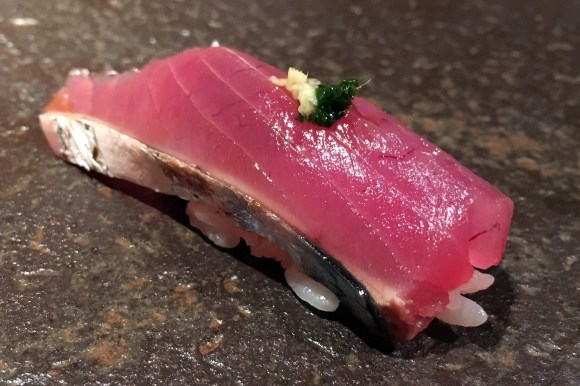
201506_daruma-ya_05

It’s not often I get to eat like I ate at Sushi Azabu. For one, this restaurant is well out of my price range. To me, an expensive meal is any one that threatens to hit the $30 mark, and with omakase is priced at $100, $150, or $180 per person, Azabu is far past the point of threatening. Don’t get me wrong; I can definitely appreciate a high-quality meal. I’m not one to immediately cry “overpriced!” at anything that veers toward costliness. It’s just that I can’t afford to eat this way unless someone else is footing the bill (thanks, Dad).

A few months ago, in a fit of bitterness, I went through the menus of every single one of this city’s Michelin-starred restaurants, mostly in an attempt to prove to myself that fine dining can be nut-free. I had very little success—I ended up eliminating nearly every single restaurant before even reaching my call-and-double-check stage—but one of the few restaurants that made it through was Sushi Azabu, a one-star sushi bar on the edge of Tribeca.

Their menu looks nut-less, but there’s plenty of room for nuts to sneak in under listings like “2 kinds of starter” or “dessert,” so I called to double-check. The hostess, who was very friendly and very competent, explained that while there are no nuts currently used in Azabu’s food, there are nuts stored in their kitchen. She assured me that the nuts aren’t really handled, though, and that I didn’t really have much reason to worry, especially if I was planning on eating from the sushi bar. (Of course, I’d recommend double-checking on the whole nut situation before eating at Azabu, because I’m sure it’s subject to change.)

When Sam and I got there, the hostess confirmed that I was the one with the nut allergy—I hadn’t even had to remind her. She led us to the end of the sushi bar, took our orders, and then asked if we had any special requests beyond the whole no-nuts thing before relaying all the relevant information (in Japanese) to the sushi chef. Truly, I felt taken care of—she was just as helpful in the restaurant as she had been on the phone, and if I’d had any worries beforehand, they were gone by the time she and I were done speaking.

[By the way, Azabu is a very small and very quiet restaurant. Only an (a) jackass or (b) Actual Important Restaurant Critic™ would be comfortable subjecting the other diners to a shutter sound over and over and over and over, and (I hope) I’m neither, so I left my camera at home. The photo at the top of this post, though I wish it were mine, is from The Greenwich Hotel’s website. I’ve included a few of my own iPhone photos at the end of this post, but those are all I have. Find a few better ones here and here.]

Anyway, food. Sam and I ordered the less expensive of the two Chef’s Omakase options. For $150, we each got got two starters, an assortment of seasonal sashimi, an uni tasting, a grilled crab dish, an assortment of sushi, miso soup, and dessert. (At $180, the other Chef’s Omakase also includes a toro tasting.)

First came the starters: fluke topped with uni, and a piece of Japanese eggplant topped with seared fatty tuna. Both were great, but I particularly liked the tuna, because…well, it was seared fatty tuna. Do I really need to explain? The eggplant was a little too slimy for me, but I appreciated its flavor nonetheless, and it did go well with the tuna, so I couldn’t really complain. And the fluke and uni were both great—I’m a sucker for any (decent) uni, really, but that serving was particularly tasty, and I couldn’t wait for the rest that’d be coming my way.

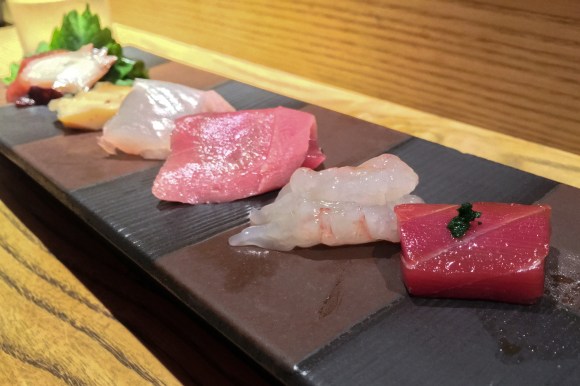
Next was the sashimi: octopus, abalone, fluke, medium fatty tuna, sweet shrimp, and lean tuna. Both pieces of tuna were straight-up delicious; the fatty tuna melted in my mouth, as fatty tuna does, and the lean tuna, topped with a speck of scallion, was one of the best pieces of lean tuna I’ve ever eaten. Seriously: That thing blew me away, and if my eyes had been closed, I wouldn’t have known it was lean. I liked the sweet shrimp, too—it didn’t have any of that that sea flavor that I so hate—but the octopus was a little boring, and the abalone was way too tough and clammy (that’s clam-flavored, not damp) for me.

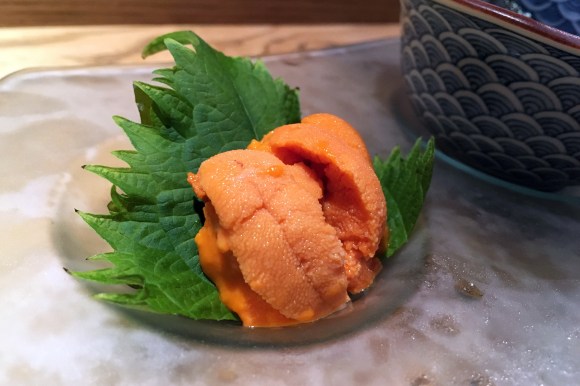
After the sashimi came the uni tasting, which I’d been looking forward to since the very first moment I laid eyes on Azabu’s menu. We were each given two types of uni, both from Hokkaido: one from the North, and one from the East. Sam and I both preferred the former—it was a little creamier—but both were great, and my only complaint was that there wasn’t more. For some reason, I’d imagined the uni tasting to consist of, like, three or four varieties, but you know what? These two were certainly good enough to satisfy me.

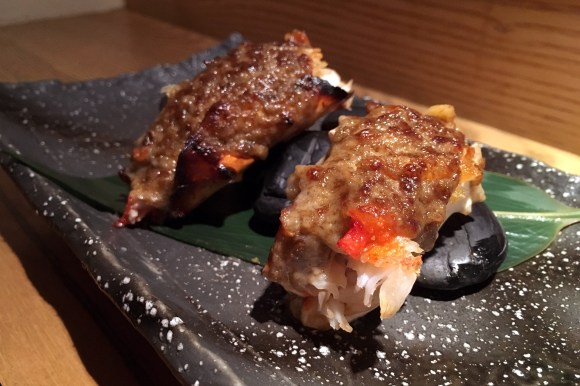
The grilled king crab came next, and honestly, it impressed the hell out of me. The meat was sweet and briny, and it came in a half-shell, so I didn’t have to fight to get at it. (What can I say? I’m lazy.) The best part, though, was the crab miso sauce, which was sweet, salty, and almost a little buttery. It complemented the meat wonderfully, but it was great on its own, too—and it was all I could do to keep myself from licking up the bits that’d spilled. (Sue me.)

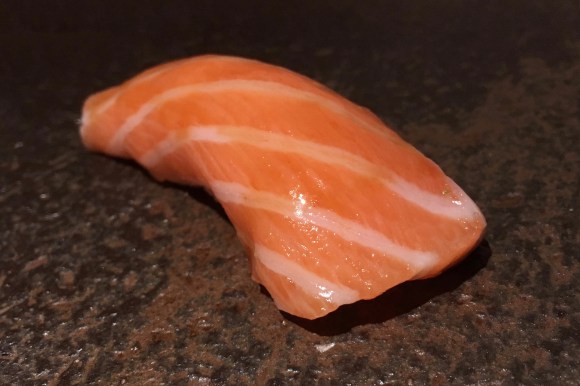
And then…and then…it was time for the sushi. We had, in order: squid, salmon, lean tuna, medium fatty tuna, scallop, bonito, ikura, a mystery fish whose name I didn’t quite catch, sweet shrimp, uni, and eel—and a tuna, oshinko, and shiso roll, too. The scallop was dense and boring, and the shrimp was a little too bitter, but everything else was downright incredible. Both pieces of tuna all but dissolved on my tongue, and the salmon—usually a pretty boring fish—was some of the best I’ve had in a while. The squid stood out, too—it was perhaps the most tender piece of squid I’ve ever had—and the uni was just as good as the better of the two from the sampling.

The roll was the last of the sushi selection, and it was a lovely way to end that portion of the meal. I love tuna, I love oshinko, and I love shiso, so it was no surprise that I went a little crazy over that roll. Its flavors and textures just worked so well together…ugh. I was full enough, but I could’ve used, like, fifteen more pieces of that thing.

A few minutes later, after we’d downed some unusually good miso soup, our chef asked us whether there was anything else we’d like to order, or if we’d rather just proceed to dessert. Now, I’d been wanting to eat some near-raw wagyu for a while—I’m not kidding; it was an actual craving of mine—so we went for it: two pieces of torched wagyu sushi, please.

It. Was. So. Good. For real: It was all I’d dreamed of. It started out tender and greasy—almost like a good steak—but as I got past the torched exterior, it got chewier, sweeter and…er, bloodier-tasting. The rawest parts tasted just like the smell of the butcher section at my local Whole Foods: a smell that never fails to make me want to eat a pile of raw beef. (The way I’m describing this is probably making me come off as a total weirdo. Maybe I am, but trust me, the wagyu was damn good.)

After we finished fawning over the wagyu, and after the chef confirmed that we were satisfied with our meal, the hostess brought out our dessert. “Mango sorbet, no nuts,” she said—without having been asked (!!!)—as she placed our bowls in front of us. I’d been a bit worried about dessert, but the fact that she seemed to have taken it upon herself to double-check made me feel comfortable enough to dig in, and so I did. The sorbet was good (though it was nothing in comparison to the meal we’d just had), but I could’ve sworn it was Häagen-Dazs. Maybe not. I don’t know. But I would’ve bet on it.

…And then, just like that, it was over.

It ended too soon, but it really was a great experience. The service was impeccable, the food bordered on perfect, and the atmosphere was calm and pleasant (despite the couple next to me, who spent the entire meal trying to perform for an audience that didn’t give a third of a shit about them). I’d love to go back, but it’ll probably be a while. Until then, I’ll just have to keep reliving this meal in my head.

Find Sushi Azabu at 428 Greenwich Street, between Laight and Vestry. (By the way, the restaurant’s underground—underneath another restaurant, actually. There’s signage, but not much of it. Try not to trip down the world’s darkest stairs on the way down.)

[Edit: I’ve since returned. Twice. And I’m happy to announce that Sushi Azabu is officially my favorite restaurant. Ever.]

Tagged , , , , , ,

Chikarashi

chikarashi

Poke is New York City’s newest fast-casual trend, and I’ve been wanting to get in on it for a while now. It doesn’t seem like a dish that’d be filled with nuts, but most of the poke joints I’ve come across offer some pretty nutty toppings, so until now, I’ve had to stay away. The brute force method seems to be serving me well, though, because I’ve finally found a safe option: Chikarashi, a new spot on Canal Street that offers chirashi-inspired poke bowls.

Chikarashi isn’t your average counter-service restaurant, though. To start, you won’t be customizing much of anything; they pride themselves on their “curated” poke bowls, so you’ll just have to pick one. It’s headed by an actual chef (Michael Jong Lim of Neta) whose goal is to strike a balance between fine-dining and fast-casual, and he seems to have done just that. Chikarashi’s food is high-quality—their fish arrives fresh daily, all their seasonings and sauces are made in house, and they have actual specials that vary by the day—but it’s quick, easy, and (relatively!) inexpensive, too. The food’s great, the prices are reasonable, and…well, I’m a fan.

Before I get started, I should probably explain a few things. Poke (which rhymes with “okay,” though it’s correctly spelled without the frustratingly common acute accent on the e) is basically a Hawaiian (raw) fish salad, usually made with tuna. In its base form, the dish has heavy Japanese influences, but Chikarashi’s spin on it is especially Japanese. I’m not sure I’d even classify their bowls as poke—but they do, so I suppose that’s the term I’ll have to use.

With regard to allergens, Chikarashi seems to be pretty safe. Their menu’s small and simple, and though they do offer a rotating cast of off-menu specials, they’ve assured me (both via email and in person) that they don’t use any tree nuts in their food. It’d be wise, perhaps, to double-check on that, especially given how often their menu changes. But in general, I feel safe eating there. (Also, as a bonus: Chikarashi serves Dole Whips—which are nut-free, as far as I know—for dessert.)

Anyway. Like I said, Chikarashi isn’t Chipotle—the menu doesn’t leave much up to you. That’s for the best, though, because whoever designed (sorry, curated) their bowls clearly knows what’s up. The first time I went, I ordered the Ponzu Salmon (salmon, wasabi ponzu, shiso, avocado, tobiko, and shichimi—pictured below, under some really yellow lighting). The smaller size cost me $12.99, and I probably would’ve minded, had it not been so good. The salmon was fresh, the avocado was ripe, and the shiso and tobiko were plentiful, which I appreciated. (Everyone’s so stingy with their tobiko. It’s awful.) I didn’t taste any wasabi, but I certainly tasted ponzu—and everyone knows I love ponzu.

Since then, I’ve eaten the Ponzu Salmon a few more times, and it’s been great (though a little different) each time. Sometimes, there are sesame seeds. Sometimes, there are scallions. But the dish isn’t inconsistent in a hit-or-miss sort of way; rather, it’s exciting, and it can’t seem to let me down.

IMG_5505

As good as the Ponzu Salmon is, though, I think I might prefer the Wasabi Mayo Tuna (bluefin tuna, wasabi mayonnaise, shichimi, shoyu daikon, and whatever else they happen to have thrown in that day). It sounds iffy, I know—mayo on raw fish usually sends me running—but this bowl is absurdly good. The tuna, though lean, tastes rather fatty, and the mayo adds a lovely creaminess to the dish. There’s usually nori, pickled ginger, and a whole bunch of crunchy stuff I can’t identify, too—and the bites that involve a little of everything are actually somewhat orgasmic. As a whole, the dish is a just hot enough (for me, a huge spice-coward), and I love it.

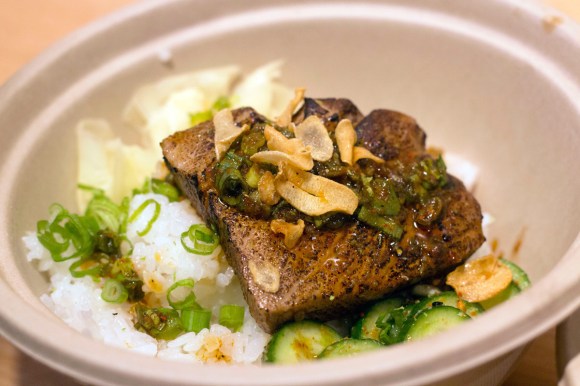
What I really want to talk about, though, is Chikarashi’s specials. Like I said, this place feels like way more of a restaurant than your average fast-casual lunch (or dinner) spot, and their crazy-good daily specials are part of the reason why. Earlier this month, I paid $34.99 for an unnamed large poke bowl made with seared otoro (pictured at the top of this post). There I was, ready to order my $12.99 Ponzu Salmon—but when the cashier told me there was otoro in the back, my plans had to change.

I wanted to hate it. I really did. I wanted to not spend the next few weeks of my life having to repeatedly talk myself out of dropping another $35 on bowl of fish and rice. For my wallet’s sake, I needed Chikarashi to disappoint me. But there was nothing disappointing about that dish. The otoro, well-seasoned and perfectly seared, actually melted in my mouth. I usually hate garlic chips, but these were actually good—and I usually can’t choke down more than a bite of cucumber, but I liked this bowl’s sesame-heavy slices. I always love ginger and I always love scallions, so those two were a no-brainer—but seriously: everything in that bowl was great.

The Roasted Salmon Kama, another off-menu special, is almost as good as the seared otoro, and at $16.99 for a large, it’s certainly a little more wallet-friendly. The portion of salmon is (of course) much larger than the otoro bowl’s portion of tuna, and you get to choose your sauce, too, which is nice. The cashier recommended ponzu, so ponzu it was, and boy, was I pleased. The salmon itself was great—the skin was crispy and the flesh was oh-so-soft—and the rest of the ingredients (scallions, cucumber slices, pickled something…) complemented it nicely. In all: Great. So great. (I didn’t get a photo, but here’s one from an Instagram account I like to drool at.)

But enough about poke bowls. (By now, I think I’ve made it clear that Chikarashi’s are kick-ass.) Let’s talk about Dole Whips, mankind’s creamiest dairy-free creation to date. According to Dole’s website, their Whips are also gluten-free, fat-free, cholesterol-free, and vegan. There’s no mention of their being nut-free, but they certainly seem to be, and the nut-allergic community loves to sing their praises, so…I figured I’d give them a try.

Chikarashi sells pineapple Whips (and floats) as well as a rotating selection of other flavors (raspberry, on the day in question). I went with a pineapple Whip, and honestly, I was a little shocked at how good that thing was. It was dense and creamy, with an unmistakable real-pineapple flavor, and even at $4, I was happy to have sprung for it. (After all, it’s incredibly rare that I can buy a dessert that isn’t pre-packaged.)

Honestly, Chikarashi is strange, paradoxical. The experience is fast-casual, but the food just isn’t. The prices are annoying, but they’re undeniably reasonable. And the whole place is a little pretentious, but it sort of has reason to be. Odd as it is, though, I really like it—and I’d certainly recommend it to anyone into poke. Or Japanese food. (Or soft serve!)

Find Chikarashi at 227 Canal Street, between Centre and Baxter.

Tagged , , , , , , ,

Mika Japanese Cuisine & Bar

A plate of sushi and rolls from

Another all-you-can-eat sushi post, another apology. Here’s the obligatory “I am sorry—this is a little gross, both in concept and in flavor. Get real sushi, please.” At this point, these posts (and especially their many apologies) are getting a little tired, but whaddya gonna do? I ate at Mika, so you’re going to hear about it—and I feel bad, so I’m going to apologize.

Now that I’ve let that out, we can proceed. Let’s.

I’m not sure where I read about Mika, but somehow, the restaurant made its way onto my to-call list. I never really got around to calling, though, until I recognized their name one night as I was walking home. I hadn’t known Mika was so close to my apartment, and I guess the realization sparked my half-interest, because I ended up calling the next day. No nuts in house, they told me—so I moved them to my to-try list, and for a while, that was that.

If you can imagine a person whose cravings are even more persistent and unreasonable than mine, then you can imagine my boyfriend, Sam. For weeks, he had Mika on the brain, and no matter how much I tried to talk him out of going, he remained resolute. Eventually, as the result of a bargain of sorts, Sam ended up with the privilege (read: burden) of choosing singlehandedly that night’s restaurant—and that was how we ended up at Mika.

To the point. When we went, it was storming, and Mika seemed to be having an off night. It’s a big restaurant with lots and lots of tables, but that night, no one was feeling it. The bar was empty, the tables (save for two) were empty, and there didn’t appear to be many employees on duty, either. Sam and I attributed the emptiness to the storm, but it was eery regardless—especially as we sat alone, in the dark, in the corner of the restaurant’s largest room.

IMG_5130

Like Yuka, Mika takes all-you-can-eat orders via paper form. For our first round of food, we ordered beef fried rice (pictured immediately above), fried calamari (pictured below), shrimp tempura, and, of course, a bunch of rolls and quite a few pieces of nigiri (some pictured at the top of this post).

First came the fried food. The fried rice—a huge portion, which we couldn’t help but read as an attempt to fill us up quickly—was all right, though I don’t think I’d order it again. The rice itself was fine, and the vegetables were inoffensive, but the beef was tough and tasted overwhelmingly of char. Still, we chewed our way through the entire serving, hoping there’d be better flavors to come.

The shrimp tempura was better, but not by much. Again, it was a big portion—four large pieces of shrimp—but the dish was certainly more manageable than the fried rice. Flavor-wise, the tempura was bland, and the dipping sauce didn’t do much to remedy that, but again: an inoffensive dish. We got it down without issue (and so avoided being charged extra), which was what really mattered.

The calamari, though, was the stand-out. To our surprise, it was actually good—good enough that we ended up ordering a second helping. Unlike pretty much everything else we’d ordered, the squid itself was flavorful, and its texture was perfect—neither mushy nor tough, but enjoyably chewy. The dipping sauce (basically sweet and sour) wasn’t my thing, but still. I liked the calamari. It was (by far) the best thing we ordered.

Calamari from

With regard to the sushi, I had mixed feelings. (Not that mixed—my feelings ranged from “ick” to “huh, okay.”) The salmon was grocery store–quality, and the ikura was worse, but the white tuna and fluke were both all right. Some pieces were watery and had obviously just been defrosted; others had passably normal textures. The rolls (one shrimp tempura, one salmon) were bearable—though both were made with lots of unripe avocado. But then we made the mistake of ordering one more, at which point things took a distinct turn for the worse.

Neither of us had ever tried a salmon skin roll, so perhaps they’re just inherently terrible. But I’ve since looked at a lot of photos, and I feel pretty confident in declaring that what we ate was not the norm. Honestly, it was disgusting—there’s very little else I can say. (An exchange that took place 30 seconds ago, for science: “Sam, what’d you think of the salmon skin roll?” His reply: “Covered in sugar-sauce, mushy shit inside, no crunch whatsoever. Gross.” Accurate.) It came with six pieces, and we sure as hell weren’t getting any further than the one we’d managed to finish together—so we had to come up with a plan, lest we end up with a surcharge. I’ll leave the rest of the story to your imaginations, though.

Anyway, Mika was all right, I guess. Their sushi was some of the worst I’ve ever eaten in a restaurant, but it wasn’t inedible or anything—and their entrees were tolerable, at least. I’m not in a rush to return, but it isn’t as if I’m orchestrating a boycott, either. (After all, our meal was really cheap, considering how much we ate.)

In all: Meh.

Find Mika at 150 Centre Street, between White and Walker.

[Apologies for the coloring of the photos in this post. Mika has some weird-ass spotlight-esque lighting, and there’s only so much I can fix in post. Forgive me.]

Tagged , , , , , ,

Hai Street Kitchen & Co.

A Slammin' Salmon f

I’m a big fan of Uma Temakeria, so I was pretty excited when I found out about Hai Street Kitchen & Co. Like Uma Temakeria, Hai Street specializes in sushi burritos…but bigger ones, with a wider range of ingredients, it seemed—and so I stood no chance. Onto my list it went.

Their only New York City location is at Urbanspace Vanderbilt, which didn’t sound ideal to me—but I figured they’d be worth looking into, at the very least. So what if Urbanspace is full of restaurants that are trendier than they are tasty? That’s a generalization; surely, there are some exceptions, and maybe Hai Street was one.

Hai Street never responded to the message I submitted via their contact form, and their Urbanspace location doesn’t have its own phone number, so I called one of their Philadelphia storefronts. The woman I spoke with assured me that nothing on Hai Street’s menu contains any nuts whatsoever, and that the same should be true of their other locations, too. I would’ve preferred to have been able to speak to an employee who was actually on-site at their Urbanspace stand, but I wasn’t all that worried—Japanese (and Japanese-inspired) food is usually pretty low-risk, so I decided to go ahead and give it a try.

Anyway, from what I could tell, Hai Street looked good. Their Yelp page is filled with photos of big-ass sushi burritos packed with generous portions of fish, and their online menu lists a bunch of appetizing ingredient options, so I figured I was in for a treat. If I’d been paying any attention at all, though, I would’ve realized that the Hai Street’s Urbanspace location doesn’t allow for customization—that is, they don’t offer the same build-your-own deal that’s advertised on the chain’s website and available at some of their other locations.

I figured it out pretty quickly when I got there, though. The menu was simple: five speciality burritos, some sides, some drinks, and some rolls. I was a little disappointed—I’d already gotten my heart set on a combination of ingredients—but I got over it. After a few minutes’ deliberation, I ended up with the Slammin’ Salmon (a burrito made with salmon, gochujang, romaine, cucumber, pickled jicama, red cabbage, and tempura crunch) with avocado salsa and without the cucumber, jicama, or cabbage. (What can I say? I wasn’t ready to let go of my ideal. The Slammin’ Salmon wasn’t it, but at least there was no cabbage involved.)

Even without three of its seven advertised components, my burrito was intensely flavorful—though the only reason for that was the homemade gochujang (which tasted much more like sesame sauce than gochujang, actually). As a whole, the burrito wasn’t all I’d dreamed of, but it certainly wasn’t bad, either. The romaine was fresh and crisp, and the rice was tolerable, which helped. The tempura crunch sucked (but I’ve never once enjoyed tempura crunch), the salmon was bland, and the avocado salsa would have been more appropriate on a Mexican taco than a Japanese-inspired dish of any sort—but nothing in my burrito was particularly offensive, so…I did enjoy it. For the most part.

Was I underwhelmed? Yes. Slightly annoyed that I’d just spent $15 for something so mediocre? Um, yes. Still bitter about the fact that I wasn’t able to add the pickled onions and fried shallots I’d seen online? Yes. But you know what? I’d probably eat at Hai Street again, given the right set of cravings—though probably only if I happened to be passing by. My allegiance still lies with Uma Temakeria, but I suppose there’s room for both restaurants in my life.

Find Hai Street Kitchen & Co. at Urbanspace Vanderbilt, which is located at 230 Park Avenue, between 45th and 46th Streets.

Tagged , , , , , ,

Katz’s Delicatessen and the City’s Most Legendary Pastrami Sandwich

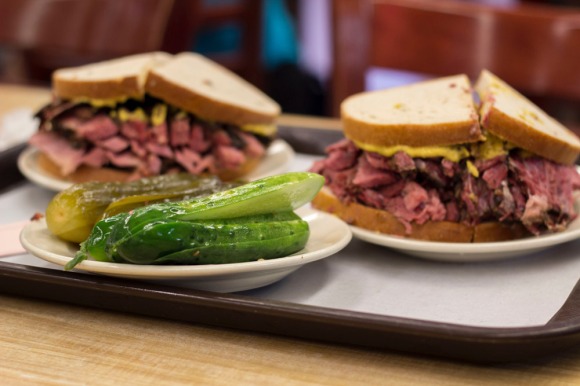
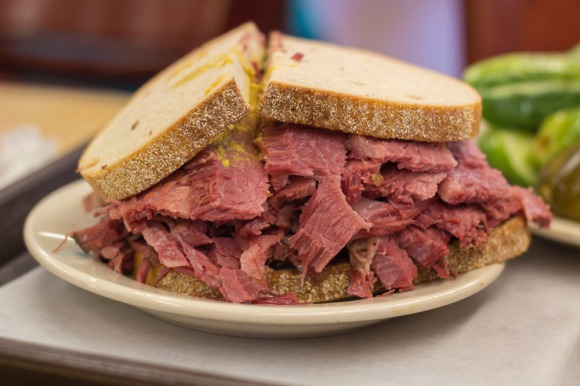
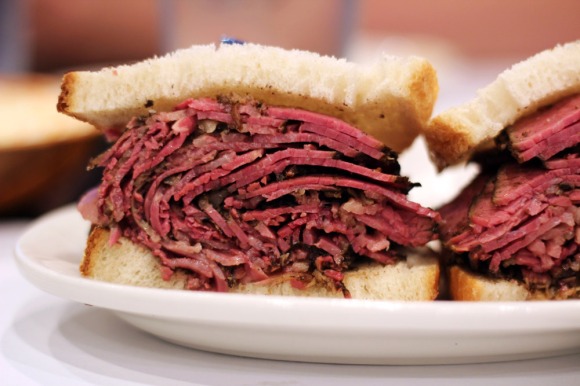
A plate of pickles, a pastrami on rye, and a corned beef on rye at Katz's Delicatessen

“For most New Yorkers, deli means pastrami, and pastrami means Katz’s. This is simply a fact of life, like death and taxes.”

*     *     *

Katz’s Delicatessen, easily one of this city’s most iconic restaurants. It’s been hanging around the Lower East Side for almost 130 years now, and in that time, tourists and New Yorkers alike have come to cherish its kosher-style food. Their pastrami sandwich is on every list of things you’re supposed to eat in this city—and you know what? You probably can, nut allergy be damned.

I’m in the process of breaking a bad habit of assuming I can’t eat any of the hyped-up foods everyone’s always talking about. Sure, it’s probably a valid assumption when it comes to some things (Dominique Ansel’s cronut, or—ugh, I need this—his burrata soft serve), but I’ve proven to myself time and time again that I can, in fact, get in on a lot of the trendy and/or iconic (read: uh, touristy) foods this city has to offer. Turns out, getting off my ass and asking questions actually pays off more often than I’d ever expected—and I suppose I have this blog to thank for that realization.

Since I started eating at Essen, I’ve been on quite the pastrami kick. It was that kick that led me to email Katz’s last week. I asked a few questions about nuts and cross-contamination, but the response I received was underwhelming, to say the least: “No nut products.” That was it. So I called, and while the experience was a bit painful (it involved, for some reason, lots of “can you just call back in 15 minutes?”), the results were well worth the effort.

The folks at Katz’s do not cook with nuts. However, they do carry a number of baked goods (babka, etc.) made elsewhere that may not be free from cross-contamination. No word on whether or not those baked goods actually contain nuts—their babka is rumored to be made by Green’s, actually—but I’ve been told to avoid them regardless. No big deal, really; I don’t think anyone goes to Katz’s for the overpriced desserts.

We need to have a talk about Katz’s ever-important rye bread, though. It’s supplied by Rockland Bakery, whose allergen information is confusing as hell, to say the least. At Katz’s, the Rockland bags are made of wax paper and are without any sort of “may contain” warning. I’ve seen other Rockland rye bags, though—at Frankel’s Delicatessen, for example—that are made of plastic and that do bear a “may contain” warning, right above the nutritional information panel. Strange.

Naturally, I called Rockland to find out what was up, and the woman I spoke with (who worked in Rockland’s retail department, the only department I had any luck reaching by phone) told me in no uncertain terms that Rockland makes only one type of rye, and that they do make that rye on equipment that’s also used for their nut-containing breads. So that’s that, then, I guess? Nope.

At that point, I’d been eating their rye for weeks without issue, and I’d decided to continue to do so because (a) it had been fine so far and (b) I love Katz’s. But I wanted to be certain about the risks I was taking, so I sent Rockland an(other) email in an attempt to perhaps find out about any measures they were taking to reduce the risk of cross-contamination. The reply I received, from Rockland’s Food Safety Manager, was as follows:

Thank you for contacting us regarding your concern on the allergen in our facility. I would like to inform you, our Rye bread is manufactured in a plant that is tree nut free and no equipment is shared with any tree nuts or any kind of nuts.
We are a HACCP certified company with specific programs and cleaning procedures to prevent cross contamination as well we have programs to control any use of allergens.
The allergen disclaimer on the bag, it is a generic statement found on all Rockland Bakery products, and in most cases, it is requested by our customers or governmental offices, however, like in the case of the Rye bread, it really doesn’t apply.
If Katz and Frankel’s, in fact are using our Rye bread, in both cases, the bread is free of any tree nut and nuts contamination.

I sent a few more emails to a few more addresses to be absolutely certain that above information was, in fact, accurate, but I didn’t get much back…except for what seems to be Rockland’s official allergen statement, which I’ve attached here. (Spoiler: It’s consistent with the above email, which comes as no surprise, because it was written by the same guy.) Good news, I guess.

While I don’t like how much misinformation I received—inconsistent answers are one of the easiest ways for a company to put me off—I’m inclined to trust that Rockland’s rye is made in a nut-free facility. Of course, I understand that such hubbub is enough to sour many nut-allergics on Rockland (and Katz’s, by extension). It may have been a deal-breaker for me, too, if I’d gone through all this before I got myself addicted to this goddamn pastrami. Too late now, though. (Plus, I really do believe that Rockland’s bread is safe.)

That is, of course, just my personal stance, and as always, you should only eat where you’re comfortable eating. My goal in rambling like this is to provide you with (more than) enough information to come to your own conclusions about Katz’s and their rye. (And by the way, it’s certainly possible to avoid bread at Katz’s. You can order the meat on its own, or you can go for any of their other bread-less offerings, though neither of those options is, uh, canon. Still, doable. I recommend the three-meat platter.)

Anyway. All I can say, really, is that Katz’s works for me. Proceed past the following salami wall at your own risk.

IMG_5070

Katz’s is loud and chaotic and almost always packed to capacity (with ding-dongs, no less), but all that’s easy enough to ignore—just focus on the smell of the meat. When you walk in, you’re given a ticket (don’t lose it or you’ll be out $50), and then you’re on your own. If you choose to go the self-service route, you’ll eventually figure out that you’re meant to take your little ticket to the appropriate counter and use it to order some food. If you’re getting a sandwich (as you should be), you’ll want to tip the dude who slices your meat, and then you’ll want to take your drooling ass to a table and get to business before anything goes the slightest bit cold.

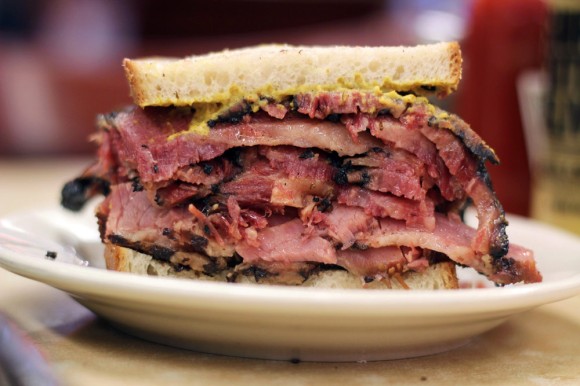
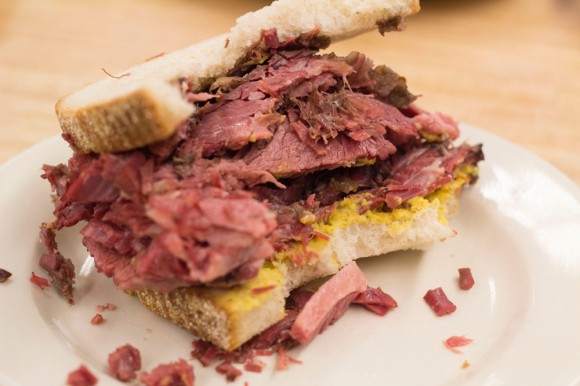
The first time we went, Sam and I both ordered pastrami on rye—a mistake, considering how huge those sandwiches are. (Half of one is pictured below, in a bit of disarray, because I’m a klutz.) To our delight, our cutter let us sample some hot pastrami before he piled it onto our sandwiches. (Apparently, that’s SOP; we’d had no idea.) Over the din, he looked for our approval, and over the din, we gave it. And then it was sandwich time.

IMG_5033

The sandwich. The sandwich. The sandwich. I’d really rather not play into the circle-jerk, but my honest-to-goodness opinion is that this sandwich is about as good as it’s reputed to be. It didn’t change my life. It didn’t stop my heart. It isn’t the best thing I’ve ever eaten. But it’s absolutely delicious. That much is undeniable. The pastrami, thick-cut and peppery, really does melt in your mouth. It’s very fatty, though not sickeningly so, and the sour of the mustard complements it wonderfully. The rye is just okay, but really, who cares? It’s all about that pastrami, baby. And the pastrami is damn good.

The corned beef (pictured below—first untouched, and then in the inevitable state of disarray) is wonderful, too. So wonderful, in fact, that some days, I even prefer it to the pastrami. (Which I like more depends on little more than which I had last. Seriously: Corned beef is criminally underrated.) Like the pastrami, it’s incredibly tender and juicy—but it’s saltier, tangier, and to me, it tastes a little cleaner (though I’m fully aware that it isn’t “clean” by any stretch of the word).

Corned beef on rye from Katz's DelicatessenHalf a corned beef on rye from Katz's Delicatessen

If plain pastrami/corned beef sounds too boring, you’re wrong, but consider trying the Reuben. It’s made with meat (pastrami or corned beef), sauerkraut, Russian dressing, and Swiss cheese, and it’s pretty solid. I could’ve done without the Swiss, and the rye couldn’t quite hold the combination of greasy meat and wet sauerkraut, but you know what? Messy as it was, I enjoyed the hell out of the one Katz’s Reuben I’ve eaten. It’s not quite on par with its kraut-less brethren, but it’s a good option when you’re in the mood for something a little different.

I like their knishes, too. (Actually, I like stuffing fallen sandwich meat into their knishes. Same thing, right?) They’re under $5 each, which is low for Katz’s, and I like to use them to supplement my usual meal of a half sandwich. (Sam and I have fallen into the habit of splitting a sandwich and a knish. That brings the meal-for-two price down to $25, which is a lot easier on our wallets than the double-sandwiched alternative.) Katz’s offers both square and round knishes, by the way. I’m partial to the square ones, but some insist that round is the way to go. Do with that what you will.

Anyway. I’m, like, 1,700 words and 5 photos deep here, so I suppose I should probably stop going on about this place. Suffice it to say, then, that I am a huge fan of Katz’s—at lunchtime, at dinnertime, and even (and especially) at 2am on a Saturday night, when there’s hardly anyone there and the bathroom floors are covered in sawdust. There’s just something about that place that makes me happy.

And okay, a lot of that something is the food, but there’s more to it, too. The atmosphere: the bustle, the smell, even the tourists—even the misguided ones, who spring for waiter service and then insist on ordering turkey on wheat, extra mayo. The enormous dining room, the hanging salamis, the kitschy celebrity photos that cover the walls. The cutters and their perpetual need to poke fun at me. The sense of coming together over something (pastrami, duh). And, of course, the fact that even I can take part.

Find Katz’s Delicatessen at 205 East Houston Street, on the corner of Houston and Ludlow. And remember: DO NOT, UNDER ANY CIRCUMSTANCES, LOSE YOUR TICKET. (Also, here’s some further reading, because Katz’s fascinates me: a lovely description of a night at Katz’s, and an explanation of how they make their pastrami.)

Tagged , , , , , ,

Terrace Fish & Chips

Fried fish, calamari, and fries from Terrace Fish & Chip

Until last week, I had no idea how much I needed a reliable source of fried fish. But now that I’ve found Terrace Fish & Chips, there’s no unknowing what I now know: I need this stuff, and I need it often.

To tell you the truth, I have no idea how I found out about this place. I keep a list of restaurants to look into, and Terrace sort of just showed up on it. I know I must’ve added it, but I don’t even remember having heard of it. There it was, though, begging me to call and ask a bunch of repetitive questions. So I did.

The man who answered the phone assured me that there were no nuts or nut products involved in anything at Terrace—and why would there be? It’s a very straightforward place. They do fried seafood, grilled seafood, seafood salads, seafood burritos, seafood sandwiches, and seafood rice. That’s it, so it isn’t as if there’s much room for nuts. I was psyched.

The first time I went, I tried a bunch of different things (all of which I’ve ordered many times since): the fried fish, the crab sticks, the calamari, and, of course, the fries. The woman behind the counter switched around one of their (many, many) pre-set meals for me so that the above assortment would count as a combination meal (and thus cost a whole lot less), which was very nice of her—especially considering the fact that she could’ve just as easily told me to get over myself and either (a) settle for one of their six trillion pre-sets or (b) pay the menu price for all the shit I wanted, but she didn’t. She just asked what I wanted, found me a similar meal, and made the necessary substitutions. Small potatoes, but I appreciated it.

Service was quick, too. Within 5 minutes of placing my order, I was out the door—and on a bench around 20 feet away. (There are only like four chairs inside the restaurant, but there are plenty of public benches in a cute little square-like area outside, so the lack of seating doesn’t matter all that much.)

By the way, these “fish and chips” are not British-style (which is to say that they aren’t fish and chips at all). But if you go in with that in mind, everything’s still pretty good. At places like this, it’s all about your expectations, and if you walk into Terrace expecting a big heap of greasy, fried, American seafood, then you’re going to leave happy. (I know I did, at least.)

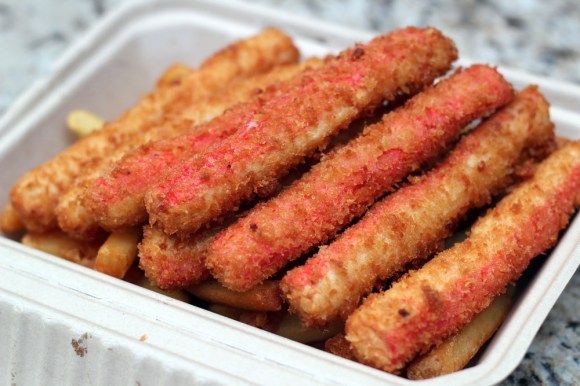
Fried crab sticks from Terrace Fish & Chip

The fried fish (pictured at the top of this post, atop calamari and fries) is boring as hell, in the best possible way. It’s the sort of boring that comforts, and I must admit that I’m a fan. It’s a little fishy, a lot crispy, and a wee bit salty—and that’s all it takes to win me over, really. It comes in huge pieces, and it’s supremely satisfying, in that way only fried food can be. Swoon.

The calamari is a little bland, too, but it isn’t unpleasant. It’s neither too tough nor too mushy—and to my surprise, tartar sauce goes a long way in brightening up the flavor. (I’d really like it to come with lemon, but oh well. Meals come with ketchup, hot sauce, and tartar sauce. I hate ketchup almost as much as I hate hot sauce, and tartar sauce is pretty hit-or-miss with me, but I’ll make do.)

The crab sticks (pictured second above) actually aren’t bland; they’re sweet and chewy—not tough, but chewy—and when they’re fresh, they’re sickeningly delicious. (I’ve tried to eat them as leftovers, and all I can say is that I do not recommend you do the same. Ick.) Aesthetically, they always remind me of the Angry Whopper—I have no idea why, because they don’t look much alike—but I can assure you these things aren’t anywhere near as revolting as any of Burger King’s latest cries for attention. They’re good, and that’s all I really have to say.

Anyway: Terrace Fish & Chips isn’t the most exciting place to eat. Their food isn’t gourmet, nor is it particularly interesting, but it’s damn good at being what it is: an inexpensive fried seafood joint that seems to have erroneously slapped the phrase “fish & chips” on its awning. [Actually, their awning says “fish & chip,” singular, but their website (and most others) say “fish & chips.” It burns.]

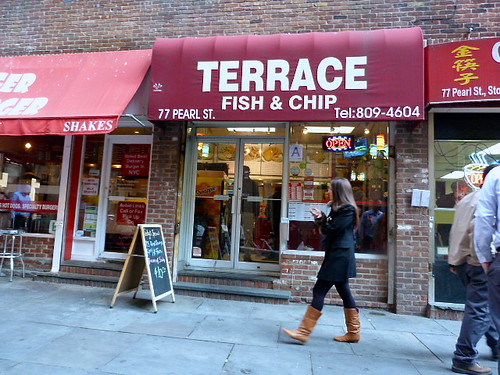
Find it at 77 Pearl Street, not too far from Pier 11/Wall St.—you know, in case you were planning a trip to IKEA or something.

Tagged , , , , , ,

Luke’s Lobster

IMG_4860

[Edit: As of 2018, Luke’s no longer has a nut-free kitchen. Almonds. In some grain bowl. Ick. Oh well.]

I’ll admit it: I’ve been actively avoiding Luke’s Lobster since I learned it was nut-free back in February. They have 13 locations, most in pretty convenient locations, but fuck—$17 for a single lobster roll? I know it’s lobster, but come on. That’s a lot! So I stayed away.

Still, the allergy information I got from Luke’s was pretty solid. There are no tree nuts (or peanuts) in any of their dishes, and their bread comes without any sort of “may contain” warnings. No one I’ve spoken to has wanted to make any guarantees about cross-contamination, but that’s standard for places that aren’t declaredly nut-free. So: Luke’s. Safe. Great. But I still didn’t want to pay $17 for an ever-so-small meal.

Last weekend, though, Sam and I really couldn’t figure out what to eat. It all started with a simple question: “What do you want for dinner?”—and two hours later, we still hadn’t gotten anywhere. I didn’t want Mexican; he didn’t want Japanese. Neither of us wanted to go to the one Chinese restaurant I can eat at, and I couldn’t talk him into cooking. In defeat, we went home—we’d been having this conversation on a bench on Houston Street—and agreed to just have a frozen dinner.

And then it hit me. Sam had been wanting to go to Luke’s since we’d first heard about it, and I…well, at that point, I was feeling pretty good about anything that didn’t need to be microwaved. “Put some pants on,” I told him. “I have an idea that I think you’re gonna like.” And that was how I ended up spending almost $40 on lobster rolls (two—only two!) on a Sunday night.

IMG_4866

We went to the Luke’s on 7th Street (not pictured above—that’s the one on South William Street), which happens to be the smallest of the chain’s locations, Tail Cart not included. It’s a special kind of rustic-kitsch hell in there. There are about eight seats, and the walls are covered with sea-themed detritus. Sea, seafood…yes, I get it. But I did not appreciate having to wait 15 minutes in a shoebox that could pass for a Maine airport gift shop, six inches from the next person over, all for an expensive-ass snack-sized meal. (Oh, and the whole place smelled funny, too. Like a cheese shop, in a bad way.)

But I let go of all my ambiance-related gripes the second I bit into my lobster roll. The meat was fresh, and it came in large, satisfying chunks—and there was plenty of it, which was key. Plus, the bun was buttery and well-toasted (well-griddled, actually, which explains why it tasted so much like the bread on a good grilled cheese), and I wasn’t even upset when I ran out of lobster and had to finish the bun off by itself—it’s that good.

The seasoning (which I’m pretty sure is, like, 80% oregano) tasted a bit out of place, and I wouldn’t have minded if there had been a bit more mayonnaise involved, but there’s no denying that overall, the roll was good. That said, it wasn’t quite good enough to make me forget how much I’d spent—and it wasn’t as if I left Luke’s feeling particularly full, either. I’m not made of money, though, so I gathered all my self-control and got the hell out of there before I had the chance to find myself down another $20 with a clam chowder in one hand and a lobster tail in the other.

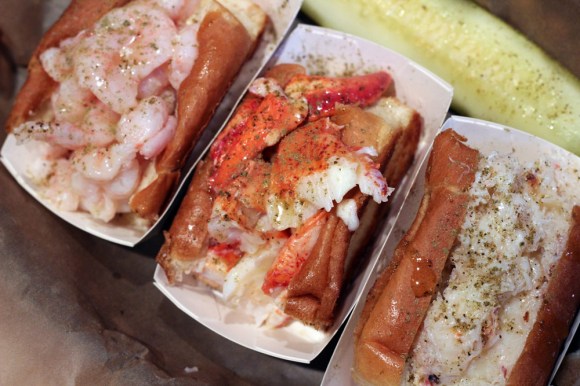
The Noah’s Ark (two half lobster rolls, two half crab rolls, two half shrimp rolls, four crab claws, two drinks, two chips or slaws, and two pickles—pictured above and below) is certainly a better deal. At $46, it feeds two—and doesn’t cost all that much more than two plain old lobster rolls. Our second time at Luke’s, we went with the Noah’s Ark, and we both left feeling far more satisfied than we’d felt the first time. All around, it was a win.

IMG_4873

Again, the buns stood out—enough to carry me through an overwhelmingly boring crab roll. The shrimp roll was better, but not by much. Unsurprisingly, the lobster was the best of the three, but I did like being able to try all of Luke’s offerings. The pickle was a pickle (a good one, I guess), and the chips (Cape Cod) were chips, but the soda was not just a soda. Luke’s sells Maine Root, which is really, really good. I had the Mexicane Cola, and I was in heaven.

I do have a complaint, though, and it’s an angry one. The crab claws (listed on the menu at an absurd $8 for 4) were a joke. Too cold, too small, too bland, too expensive—all I could think was “how much less would this meal have costed if these stupid crab claws weren’t included?” Still, if you were to buy everything included in the Noah’s Ark on its own, it’d cost you around $20 more than you’d pay for the bundle—so I couldn’t be that upset.

Overall, I like Luke’s. For my bank account’s sake, I wish I didn’t, but I can’t help it. Their lobster rolls just taste right, and I can’t convince myself otherwise—so I suppose I’ll have to learn how to exercise some restraint. (Or not, because they have a loyalty program. For every 10 lobster dishes you buy, you get a free lobster roll—and the Noah’s Ark counts for two. I’m on my way.)

There are a bunch of locations in the city, but the two I’ve been to are located at 93 East 7th Street and 26 South William Street, respectively. I preferred the William Street location, literally only because all the sea-flotsam and Maine-jetsam took up a more reasonable percentage of space than it did on 7th Street—and I’m willing to fight anyone who thinks that criterion is illegitimate.

Tagged , , , , ,

Yuka Japanese Restaurant

Yuka's all-you-can-eat menu

Listen: I’m sorry. All-you-can-eat sushi is an abhorrent concept, and I’m actually sort of ashamed to be writing about it again. But a nut-free restaurant is a nut-free restaurant, and I don’t really have the luxury of being as choosy as I’d like.

Sushi’s tough, though. Bad sushi and those who swear by it make me irrationally angry, but I can’t shake this perverse compulsion I have to try out every nut-free Japanese restaurant I come across. It doesn’t matter that the vast majority of these places are so obviously the exact type of thing that riles me up; I read about them, tell myself I’m not interested, and then find myself there within a month or two. The food’s a joke, but I don’t care. More often than not, I end up becoming a regular at these godforsaken places. It’s insane, and I have no idea what’s wrong with me.

…Let’s move on.

I first read about Yuka on this list of New York City restaurants that offer all-you-can-eat sushi deals—a list I was reading because, as I said, there’s something wrong with me. Yuka was one of the least expensive options on the list, so I gave them a call, and sure enough, they’re pretty much nut-free. There are no tree nuts or tree nut products in any of their dishes, but they do use peanuts in a roll or two of theirs. Fine by me—so on a particularly boring Sunday night, my boyfriend and I made the trek uptown.

The restaurant’s small and dark, with string lights and origami birds hanging from the ceiling. Tables are very close together—we ate about six inches from the couple next to us, both of whom kept (literally) overflowing their own glasses with canned Coke. In all, though, the atmosphere wasn’t particularly unpleasant; it was just…strange.

All-you-can-eat was indeed available—at $23.95 per person, which is a pretty good price. Your whole party doesn’t have to go for the all-you-can-eat deal, but be warned: If one person does, and the waitstaff catches the others sampling off the all-you-can-eater’s plate, all will be charged the full all-you-can-eat price. This rule—along with the others, which concern time limits and fees for leftover food—was printed on paper and secured under a layer of glass on our tabletop, along with a partial menu, a beer ad, and a sushi identification chart. Weird, but whatever.

Ordering is done with paper and pencil, which is straightforward enough (though certainly a little less fun than ordering via iPad). You can place as many orders as you’d like, but Yuka will charge you for the food you leave behind, so make sure your eyes and stomach are in-sync, lest you end up on the receiving end of a few contemptuous side-eyes. Overall, Yuka is pretty similar to most other all-you-can-eat places; there’s one real rule, and it’s “be reasonable.” If you can handle that, you’ll be fine.

Anyway, I guess I’ve avoided talking about the food itself for long enough. I hate to say this, but…it’s actually all right. It isn’t good, mind you, but it’s tolerable—and even enjoyable, if you’re prepared for what you’re getting yourself into. The sushi is better than Kikoo‘s, better than Marumi‘s, and generally just better than I’d expect of a) all-you-can-eat Japanese and b) the particularly unpleasant stretch of 2nd Avenue on which Yuka is located. And although the variety of fish isn’t all that wide, it isn’t oppressively narrow, either.

We ordered three rolls—salmon, tuna, and shrimp tempura—and a whole bunch of nigiri, too. When it comes to rolls, I like to keep it simple, especially when I’m eating at a restaurant I don’t (yet?) trust, and that isn’t just because I have food allergies. In my mind, it’s pretty tough to disgust-ify something as simple as a salmon roll, but a roll with eight different components? That’s a whole different animal—one I’m not willing to bet on.

When we started to eat, the first thing I noticed was the temperature of the rice. Unlike most sushi joints toward the worse end of the spectrum, Yuka’s rice isn’t even the slightest bit cold. In fact, it’s almost too warm, but when it comes to rice, I’ll take too-warm over too-cold any day. Most of the fish is an inoffensive room-temperature, but some pieces are inexplicably cold, which is very off-putting, to say the least. For the most part, though, temperatures are solid. Such a relief.

That first night, our rolls surprised me. Salmon and tuna were simple and pleasant, and shrimp tempura was refreshingly no-nonsense. I’ve gotten used to restaurants putting some crazy shit (ranch? RANCH?!) in their shrimp tempura rolls, but the folks at Yuka seem to know better. They use shrimp, avocado, rice, and seaweed—no cucumber, which was strange, but fine by me—and it’s actually not half bad. (If you’re trying to strategize, though, stay away from this one. It’s the most filling thing I’ve eaten at Yuka.)

Truthfully, the nigiri was even more surprising. The salmon was buttery; the squid was nice and firm, without bordering on tough; and the shrimp was sweet, though a bit boring. The whitefish and the yellowtail were both very cold and very bland, but I got over it. I was paying less than $25; what right did I really have to complain?

And that’s the thing: I expected very, very little of Yuka, so naturally, I ended up with a better meal than I’d prepared for. Perhaps that’s why I don’t find myself descending into an irrational fit of rage every time I walk through Yuka’s doors—well, that and the whole unlimited-food-for-cheap thing. For what it is, Yuka is actually pretty great. It isn’t high-end, and it’s full of misguided Upper East Siders, but you know what? It’s cheap, it’s easy, and it’s satisfying—and it’s way, way better than most other sushi at its price point.

Find Yuka at 1557 2nd Avenue, between 80th and 81st. It’s pretty far uptown, but that’s fine—you can use your train ride to mentally prepare yourself for the absurd amount of food you’re about to (try to) choke down.

[Sorry about the lack of photos in this post. I tried, but I couldn’t get a single decent picture of the food itself. It’s dark in there, and things move really quickly. I’ve failed you; try Yelp.]

Tagged , , , , , ,

Essen New York Deli, Part I

A pastrami sandwich from Essen NY Deli

Man, Jewish delis are the best.

I’ve had a lot of luck with kosher food, but until now, that luck has been reserved for baked goods. I’d never been able to find a nut-free delicatessen—that is, until I heard about Essen, a glatt kosher deli in Midwood, Brooklyn that happens not to have any nuts in house.

It sounded too good to be true, so I sent Essen an email to double-check. The response I received, in its entirety, was as follows: “Hi, we do not cook with any nuts but we are not a 100% nut free environment. Any questions please call us.” That response could have meant a whole lot of different things, so I did end up calling with a few further questions.

After being transferred a few times, I ended up on the phone with someone who really seemed to know what he was talking about. He explained to me that, while they don’t cook with any nuts at Essen, they don’t like to call their food “nut-free,” as they have no means of controlling what their customers (or employees) bring in with them. They prefer to say that they make food without nuts so as not to mislead anyone with severe allergies. So far, so fair.

Bread’s trouble, though, and I wasn’t about to make a trip to Midwood without the promise of a sandwich, so I was sure to double-check on that, too. With me still on the line, the man on the phone called up his bread supplier, put him on speakerphone, and asked him whether there might be any nut traces in their rye or club breads. The answer was “no,” and that was that. Within 30 minutes, I was riding the Q to Avenue J.

[Before I move on, I’d like to emphasize just how competent and knowledgeable this guy was. I asked what “we are not a 100% nut free environment” meant, and without a second’s hesitation, he jumped into an explanation that demonstrated a degree of allergy awareness that was really refreshing—especially at the tail end of a few hours of restaurant-calling. He was patient, clear, and actually helpful, and I was incredibly grateful. Serious props to the folks at Essen for that one.]

The restaurant’s bigger than I expected it to be, with a few different rooms full of tables. There’s counter service at the front, and it’s easy enough to get food to-go, but Sam and I opted to eat in (mostly because I’m absolutely hopeless when it comes photographing food without a table to help me out). Ourselves excluded, all the patrons were Jewish—and most seemed to know one another, too. We got a lot of funny looks, but such is life in an Orthodox neighborhood for even the most modestly dressed of goyim. In all, everyone was friendly enough.

Essen has two menus: one Chinese and one with traditional deli food. Before I’d even sat down, I knew I’d be ordering the hot pastrami on rye. (How could I have considered anything else? Pastrami’s at the base of my need-hierarchy pyramid.) Sam got the Yitzy’s Favorite Deluxe (fried skirt steak with gravy on a club roll), which came with french fries and onion rings—and as we tend to, we split both sandwiches.

First came the cole slaw and pickles, though. The cole slaw was good, if a bit sweet—though it was much, much better after a few too many bites of pastrami. There were two types of pickles: half-sours, which were all right, and full-sours, which I much preferred. The full-sours tasted inexplicably like salami, but we didn’t care much. We ate them quickly, and our sandwiches arrived soon after.

The pastrami on rye (pictured above) cost $14.95, and it was worth every last penny. Fatty, tender, and juicy, the pastrami itself was really tasty, if a bit thin-cut—and the bread wasn’t half bad, either. It held its integrity, at least. (I tend to hate rye, but how can you hate anything that’s acting as a vehicle for a few inches of freshly-carved meat? You can’t.) As a whole, the sandwich was simple and delicious, and I’d already begun to crave another within an hour of finishing my first. (Unfortunately—or fortunately, perhaps—I was back in Manhattan by then. Oh well.)

The Yitzy’s Favorite ($22.95) wasn’t my favorite, though I didn’t actually dislike it in the slightest. It wasn’t at all bad, but the fried steak just wasn’t anywhere near as good as the pastrami, and the club bread was worse than the rye, too. I loved the gravy, but the sandwich was a little boring overall—and it’d cost $8 more than the pastrami, which just made me feel like I was paying more to miss out. Nothing was wrong, but I’m not exactly in a rush to order the Yitzy’s Favorite again.

The fries it came with were pretty terrible, by the way. (Like, inedibly bad. Neither Sam nor I could get through them, which is sort of saying a lot.) And the onion rings were not onion rings; they were strands of hot onion adorned every few inches with clusters of fried batter. Regardless, they were delicious, though certainly a little strange.

With tax and tip, the meal was on the expensive side, but I maintain that it was absolutely worth its price. Fortunately, Essen is far enough away that I can’t stop by every day, which should go a long way in keeping me from going broke. Their menu’s pretty big, and I’ve only eaten two of its offerings, but you know what? I’m ready to say with confidence that I love this place.

Perhaps one day I’ll let go of the pastrami (yeah, right) and try out the rest of the menu. I’d like to try their knishes, or their matzah ball soup, or maybe some of their other sandwiches, at least. Perhaps I’ll even get around to trying a few things off their Chinese menu—though I think that’ll probably deserve a post of its own. (That’ll be part II—stay tuned.) But for now, it’s pastrami for me.

Find Essen New York Deli at 1359 Coney Island Avenue, between Avenue J and Avenue K. (It’s not that far away, really. From Manhattan, it’s 40 minutes on the Q, tops—way less if you’re starting off downtown.) Beware, though: They are Jewish, so they won’t be open on Shabbat. They close at 2pm on Fridays, and they don’t reopen till 11am Sunday mornings.

Tagged , , , , ,