Category Archives: Sweets

Frankel’s Delicatessen & Appetizing

The #3 specialty combo from Frankel's Delicatessen

[Edit: As of late 2017, Baz Bagel—the bakery that makes the bagels used at Frankel’s—no longer has a nut-free kitchen. The gluten-free bagels at Baz are now made with almond flour, and since they’re made in the same kitchen (and on the same equipment) as the regular bagels, I’m no longer on board. So that…slims the pickings at Frankel’s quite a bit, doesn’t it?]

My dad is notoriously terrible at handling my allergies. He’s convinced he can determine with a glance whether a pastry contains nuts, and he has a habit of insisting that restaurants are nut-free based on nothing more than his own intuition. It’d be one thing if he had some sort of inexplicably high success rate with these things, but he doesn’t, so I’ve learned to ignore his suggestions—or at least to be sure to thoroughly vet them myself.

That said, he was onto something when he suggested Frankel’s, a Greenpoint delicatessen that opened this past spring. The folks at Frankel’s—the Frankel brothers, rather—don’t cook with nuts, meaning there are no nuts or nut products in their kitchen. Their pastries are supplied by Green’s and their bagels by Baz; plus, they sell Utz and Zapp’s chips, which are both made in a nut-free facility. Knowing all that, one might start to get the idea that Frankel’s is intentionally nut-free—but it isn’t, as far as I know. [Edit: Actually, it is. See the edit below.]

Their rye bread (supplied by Rockland Bakerydoes come with a “may contain” warning, but the matter isn’t so simple. I’ve actually been told by Rockland’s Food Safety Manager that the rye is made in a nut-free facility—but I can’t be sure, as the information I’ve gotten from Rockland has been inconsistent, to say the least. Katz’s Delicatessen uses Rockland’s rye, too—so rather than re-spieling, I’ll just direct you to the first few paragraphs of my post on Katz’s.

I’ve eaten Rockland’s rye at Katz’s and at Frankel’s countless times without issue, but that doesn’t necessarily mean you should follow my lead. Use your own discretion, obviously—and if you aren’t comfortable with Frankel’s rye, the good news is that it’s easy enough to avoid, as you can order pretty much anything you want on a bagel. (As bread goes, Frankel’s also offers rolls and challah, but both are supplied by Amy’s Bread, which is not an allergy-friendly company, so I’ll just stick to recommending the bagels—and maybe the rye, depending on whom at Rockland you trust).

And while I’m ironing out allergen information, I should probably mention that Frankel’s gets their fish from Acme Smoked Fish (who don’t use have any nuts in their New York facility), and that they get some of their meats from a nearby warehouse that they don’t seem to want to name. It doesn’t seem as though they do all that much in house, which costs them a few points on the allergy-friendliness scale—but really, whaddya gonna do? I’ve eaten at Frankel’s without issue quite a few times now, and I feel it’s worth a post, at the very least. Your standards may differ, and that’s fine. This is my blog, after all.

[Edit: A week or two after publishing this post, I received an email from someone who identified herself as a part of the Frankel’s team, saying that Frankel’s is, indeed, intentionally nut-free. Evidently, their executive chef, Ashley Berman, is allergic to peanuts—and while she isn’t allergic to tree nuts, the folks at Frankel’s evidently do their best to maintain an environment that’s 100% nut-free. (Apparently, Berman has worked with Amy’s Bread for years, and she’s comfortable with their handling of allergens. When it comes to breads, though, peanuts are certainly much easier to avoid than tree nuts—so do with that information what you will.) Good news nonetheless, though. I had a feeling something was up!]

Pastrami, egg, and cheese on a plain bagel from Frankel's Delicatessen

You know, for a Food Allergy Blogger™, I have an unusual amount of hatred for blogging about food allergies. Spelling out allergen information isn’t any fun; I much prefer eating and/or talking—writing—about eating. Onto the fun part, then.

The menu at Frankel’s is small and simple, but that doesn’t make it any easier to decide on what to order. I’m not the biggest fan of Baz’s bagels—I wrote some nice things about them back in June, but I’ve since come out of my bagel-deprived stupor and realized that theirs are rather underwhelming, to say the least—but the idea of a Frankel’s bagel sandwich had me drooling nonetheless. (Perhaps a Baz bagel would fare better out of Baz’s hands. That was my hope, at least.) Why stop at bagels, though? Frankel’s has all the classic sandwiches—pastrami, corned beef, Reubens, roast turkey, salami, chopped liver, and brisket—as well as breakfast sandwiches, hot dogs, and latkes. How was I ever supposed to make up my mind?

The first time I went, I ordered a #2 specialty combo (Nova lox, Nova spread, and salmon roe on a bagel), and to be honest, I wasn’t impressed. It wasn’t bad, but it was no different than anything I could’ve gotten at Baz, which isn’t exactly a compliment. The lox was fine, but the salmon roe wasn’t the best, nor was there very much of it—and the sandwich was made with regular cream cheese rather than Nova spread. Oops.

There was no way in hell I was giving up that quickly, though. Far sooner than I’d like to admit, I returned to Frankel’s with Sam in tow, and that time, I was able to sample a little more widely. We split two sandwiches: the #3 specialty combo (Irish organic salmon, whitefish salad, capers, onion, tomato), and the pastrami, egg, and cheese.

Now, the #3 (pictured at the top of this post) was good, but it didn’t exactly leave me wishing for another. Perhaps it would’ve, though, if the ever-important bagel itself had been good, because the whitefish salad was perfect, the onion was cut into super-thin slices that actually made sense in the context of the sandwich (for some reason, this is rare), and the tomato was fresh and flavorful. The bagel itself really left me wanting, though. Baz’s aren’t the slightest bit fluffy, and for some reason, they never taste all that fresh. It’s a shame, because the #3 was otherwise solid.

The pastrami, egg, and cheese (pictured second above, in Sam’s clutches) is another story, though. That thing never fails to make my day, no matter how many times I order it. The egg—which is actually good on its own, unlike that you’ll find in your average bodega sandwich—is absolutely smothered with melted cheese, and the pastrami is peppery, fatty, and tender as can be. The sandwich as a whole is the very definition of “melt in your mouth,” and its contents are so good that they actually manage to make up for that boring-ass Baz bagel. Seriously: Forget about bacon. Pastrami is definitely the superior meat.

frankels

The pastrami, egg, and cheese may be my favorite Frankel’s offering—if we aren’t counting their specials, that is. If we are, though, I might have to go with the heirloom tomato ordeal I had a few weeks ago (immediately above, in an iPhone photo, as I was without my camera that day). It was simple—an open-face bagel topped with tomato, basil, chives, olive oil, and just enough cream cheese—but it was surprisingly tasty.

The tomato, thick cut and actually flavorful, was one of those magnificent treasure-tomatoes you’ll only find at the farmers’ market, and the olive oil, while nothing special in itself, brought the whole creation together wonderfully. God, it was good. I wish it weren’t just a special—but I also don’t, because out-of-season tomatoes suck. (Take note, Baz.)

But don’t get me wrong: I like their simpler sandwiches, too—they just don’t excite me as much as the ones I mentioned above. The brisket (pictured below—on rye, though it usually comes on Amy’s challah) is actually made in house with Grandma Frankel’s recipe in mind, and it’s really goddamn tasty, if a bit too sweet. Plus, the bread comes griddled, which originally went a very long way in winning me over. And though the sandwich as a whole is a little one-note, it certainly makes for a satisfying meal.

IMG_5612

The pastrami and corned beef—while certainly nowhere near as good as anything you’ll find at Katz’s—are decent, too, though I’m not sure I’d order either again. On its own, the pastrami’s on the bland side. What flavor it does have is a bit too hot-doggy for me, but it’s thick-cut, fatty, and, um…present in large quantities, so there’s only so much complaining I can do. The corned beef’s a little worse, though; it just comes off as a fattier version of ham, without anywhere near enough of that signature corned beef tang. Oh well.

Anyway, Frankel’s is a neat little place…despite the fact that they don’t seem to do much of anything. I only wish it were more accessible by train. (The G’s your best bet, though it’s certainly possible to walk over from the L—until it stops running, that is.) Find it at 631 Manhattan Avenue, between Bedford and Nassau.

Tagged , , , ,

Biscoff Cookies & Cookie Butter

Two jars of

I spend a lot of time eyeing European sweets I know I can’t touch. Like, a lot of time. But for the most part, I’ve accepted that I can’t eat most of the stuff I see, and that my place in the food world—well, the European grocery world—is only that of an onlooker. Imagine my surprise, then, when I discovered that Biscoff products are safe for me to eat.

Products like these (as in: real-deal products, good products, products I actually decide I want before I know whether they’re nut-free) are almost never safe, so I was pretty shocked when I read that both Biscoff Cookies and Biscoff Cookie Butter are produced in a facility that doesn’t handle any nuts whatsoever. Don’t believe me? Check out their FAQ. (And please note that the whole nut-free thing does not apply to Annas Thins. They don’t have a “may contain” warning, but they aren’t made in a nut-free facility, and I think I’ve reacted to them before.)

Anyway, onto the products themselves. The cookies, which are pretty common on Delta flights, are tasty as hell. They’re Speculoos cookies, which are a crispy (but not particularly hard) sort of spice cookie—and Biscoff’s, rich and buttery with a nice, mild spice to them, are unusually good. A lot of lesser Speculoos products (I’m looking at you, Ben & Jerry’s) are way too cinnamon-heavy; fortunately, though, Biscoff’s are not.

Forget cookies, though. And forget allergy information. (Obviously, please don’t.) What I really want to talk about is cookie butter, which is basically a spreadable, peanut butter–textured version of a Speculoos cookie. Right now, cookie butter is pretty trendy; Trader Joe’s sells a jarred version, as well as a whole bunch of cookie butter–centric products—but few are nut allergy–safe, and none are as good as Biscoff’s real-deal jar of heaven.

Biscoff makes two varieties—smooth and crunchy—and both are wonderful. Smooth is super rich and creamy, with a peanut butter–like texture. I definitely prefer it, but the crunchy version’s great, too. It’s a little less rich, but what it lacks in flavor, it makes up for in texture. It’s packed with cookie bits, and it’s a little more fun to spoon (or finger) into your mouth than its smoother counterpart. Flavor-wise, it has a pleasant element of burnt-cookie-edge that the smooth version is lacking—but I maintain my original stance: Smooth’s a little better.

Point is, you can’t really go wrong with Biscoff. Both cookie butters great, and both are worth tracking down. They’re available online, but if you (like me) are a cheap-ass who pretty much refuses to shell out any amount of money for shipping, then you might be able to find Biscoff products at CVS, Walgreens, Rite Aid, Stop & Shop, Target, D’Agostino, Westside Market, or Gristedes. (I’ve had some trouble finding their stuff, actually. But I do know that their spreads are available at the Westside Market on 7th Avenue and 14th Street and at the Fairway on 6th Avenue between 25th and 26th. Good luck.)

Tagged , , , , , ,

Chikarashi

chikarashi

Poke is New York City’s newest fast-casual trend, and I’ve been wanting to get in on it for a while now. It doesn’t seem like a dish that’d be filled with nuts, but most of the poke joints I’ve come across offer some pretty nutty toppings, so until now, I’ve had to stay away. The brute force method seems to be serving me well, though, because I’ve finally found a safe option: Chikarashi, a new spot on Canal Street that offers chirashi-inspired poke bowls.

Chikarashi isn’t your average counter-service restaurant, though. To start, you won’t be customizing much of anything; they pride themselves on their “curated” poke bowls, so you’ll just have to pick one. It’s headed by an actual chef (Michael Jong Lim of Neta) whose goal is to strike a balance between fine-dining and fast-casual, and he seems to have done just that. Chikarashi’s food is high-quality—their fish arrives fresh daily, all their seasonings and sauces are made in house, and they have actual specials that vary by the day—but it’s quick, easy, and (relatively!) inexpensive, too. The food’s great, the prices are reasonable, and…well, I’m a fan.

Before I get started, I should probably explain a few things. Poke (which rhymes with “okay,” though it’s correctly spelled without the frustratingly common acute accent on the e) is basically a Hawaiian (raw) fish salad, usually made with tuna. In its base form, the dish has heavy Japanese influences, but Chikarashi’s spin on it is especially Japanese. I’m not sure I’d even classify their bowls as poke—but they do, so I suppose that’s the term I’ll have to use.

With regard to allergens, Chikarashi seems to be pretty safe. Their menu’s small and simple, and though they do offer a rotating cast of off-menu specials, they’ve assured me (both via email and in person) that they don’t use any tree nuts in their food. It’d be wise, perhaps, to double-check on that, especially given how often their menu changes. But in general, I feel safe eating there. (Also, as a bonus: Chikarashi serves Dole Whips—which are nut-free, as far as I know—for dessert.)

Anyway. Like I said, Chikarashi isn’t Chipotle—the menu doesn’t leave much up to you. That’s for the best, though, because whoever designed (sorry, curated) their bowls clearly knows what’s up. The first time I went, I ordered the Ponzu Salmon (salmon, wasabi ponzu, shiso, avocado, tobiko, and shichimi—pictured below, under some really yellow lighting). The smaller size cost me $12.99, and I probably would’ve minded, had it not been so good. The salmon was fresh, the avocado was ripe, and the shiso and tobiko were plentiful, which I appreciated. (Everyone’s so stingy with their tobiko. It’s awful.) I didn’t taste any wasabi, but I certainly tasted ponzu—and everyone knows I love ponzu.

Since then, I’ve eaten the Ponzu Salmon a few more times, and it’s been great (though a little different) each time. Sometimes, there are sesame seeds. Sometimes, there are scallions. But the dish isn’t inconsistent in a hit-or-miss sort of way; rather, it’s exciting, and it can’t seem to let me down.

IMG_5505

As good as the Ponzu Salmon is, though, I think I might prefer the Wasabi Mayo Tuna (bluefin tuna, wasabi mayonnaise, shichimi, shoyu daikon, and whatever else they happen to have thrown in that day). It sounds iffy, I know—mayo on raw fish usually sends me running—but this bowl is absurdly good. The tuna, though lean, tastes rather fatty, and the mayo adds a lovely creaminess to the dish. There’s usually nori, pickled ginger, and a whole bunch of crunchy stuff I can’t identify, too—and the bites that involve a little of everything are actually somewhat orgasmic. As a whole, the dish is a just hot enough (for me, a huge spice-coward), and I love it.

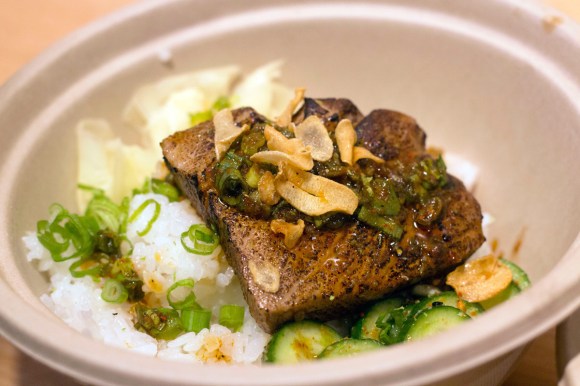
What I really want to talk about, though, is Chikarashi’s specials. Like I said, this place feels like way more of a restaurant than your average fast-casual lunch (or dinner) spot, and their crazy-good daily specials are part of the reason why. Earlier this month, I paid $34.99 for an unnamed large poke bowl made with seared otoro (pictured at the top of this post). There I was, ready to order my $12.99 Ponzu Salmon—but when the cashier told me there was otoro in the back, my plans had to change.

I wanted to hate it. I really did. I wanted to not spend the next few weeks of my life having to repeatedly talk myself out of dropping another $35 on bowl of fish and rice. For my wallet’s sake, I needed Chikarashi to disappoint me. But there was nothing disappointing about that dish. The otoro, well-seasoned and perfectly seared, actually melted in my mouth. I usually hate garlic chips, but these were actually good—and I usually can’t choke down more than a bite of cucumber, but I liked this bowl’s sesame-heavy slices. I always love ginger and I always love scallions, so those two were a no-brainer—but seriously: everything in that bowl was great.

The Roasted Salmon Kama, another off-menu special, is almost as good as the seared otoro, and at $16.99 for a large, it’s certainly a little more wallet-friendly. The portion of salmon is (of course) much larger than the otoro bowl’s portion of tuna, and you get to choose your sauce, too, which is nice. The cashier recommended ponzu, so ponzu it was, and boy, was I pleased. The salmon itself was great—the skin was crispy and the flesh was oh-so-soft—and the rest of the ingredients (scallions, cucumber slices, pickled something…) complemented it nicely. In all: Great. So great. (I didn’t get a photo, but here’s one from an Instagram account I like to drool at.)

But enough about poke bowls. (By now, I think I’ve made it clear that Chikarashi’s are kick-ass.) Let’s talk about Dole Whips, mankind’s creamiest dairy-free creation to date. According to Dole’s website, their Whips are also gluten-free, fat-free, cholesterol-free, and vegan. There’s no mention of their being nut-free, but they certainly seem to be, and the nut-allergic community loves to sing their praises, so…I figured I’d give them a try.

Chikarashi sells pineapple Whips (and floats) as well as a rotating selection of other flavors (raspberry, on the day in question). I went with a pineapple Whip, and honestly, I was a little shocked at how good that thing was. It was dense and creamy, with an unmistakable real-pineapple flavor, and even at $4, I was happy to have sprung for it. (After all, it’s incredibly rare that I can buy a dessert that isn’t pre-packaged.)

Honestly, Chikarashi is strange, paradoxical. The experience is fast-casual, but the food just isn’t. The prices are annoying, but they’re undeniably reasonable. And the whole place is a little pretentious, but it sort of has reason to be. Odd as it is, though, I really like it—and I’d certainly recommend it to anyone into poke. Or Japanese food. (Or soft serve!)

Find Chikarashi at 227 Canal Street, between Centre and Baxter.

Tagged , , , , , , ,

Touring a Nut-Free Chocolate Factory

"Happiness is Unroasted"—outside Raaka's factory

Back in March, I published a post about Raaka, a Brooklyn-based craft chocolate company that’s entirely nut-free. In that post, I noted that Raaka offers 45-minute tours of their factory in Red Hook to anyone who’s willing to part with $10 and don a hair net. It’s taken me a few months, but I finally got around to going—so I figured I’d share some photos.

Some important information first, though. None of Raaka’s products contain any gluten, dairy, soy, or nuts. Their FAQ states that no nuts are allowed in their factory, but that their chocolates aren’t certified nut-free, as they cannot guarantee that their vendors’ facilities are equally safe. Everything they sell is vegan, non-GMO, and organic—and most (if not all) of their bars are kosher, too.

(In spite of the whole vendors’-facilities thing, I’ve still categorized Raaka as truly nut-free, as their own plant is nut-free, and that’s about as much as I can ask for. Plus, I kind of like the fact that Raaka isn’t defined by its allergy-friendliness; it’s just a normal chocolate company that also happens to not use a few ingredients.)

Raaka is really big on their whole virgin chocolate thing, which refers to the fact that they use unroasted cacao beans in their chocolate-making process. As the folks at Raaka frame it, many lesser companies buy low-quality beans and then roast them to hide their flavor, which leads to a one-size, homogenous sort of product. Raaka, in an attempt to “bring you true cacao flavor,” does no such thing; instead, they buy high-quality beans and are thus unafraid to showcase those beans’ natural (unroasted) flavors. As long as it tastes good, right?

Onto the photos, though. Enjoy.

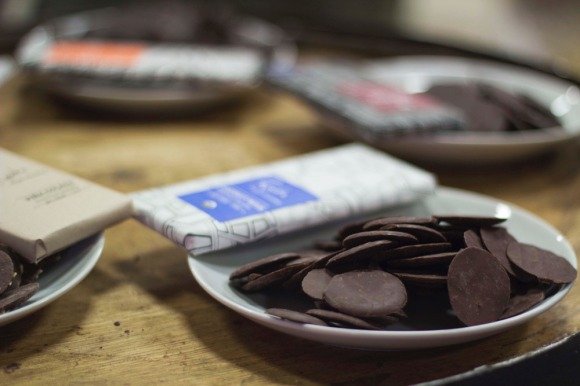
Free chocolate samples at Raaka's factory

When Sam and I walked in, we were immediately hit with the unmistakable smell of dark chocolate. We were 10 minutes early, and the woman who took our names encouraged us to help ourselves to some free samples. Of course, we did—we both tried every flavor, even though we’ve had most in bar form before—and all of them were delicious.

I found myself enjoying the sample discs way more than I’d ever enjoyed Raaka’s bars, and that’s not just because the discs were free. They’re comparatively small and soft, so they’re way less overwhelming than the bars, flavor-wise—especially if you (like me) struggle with the bitterness of dark chocolate. Seriously, though: All the flavors were great, and come tour time, Sam and I both had trouble stepping away from the chocolate, even though we knew there’d be plenty more to come.

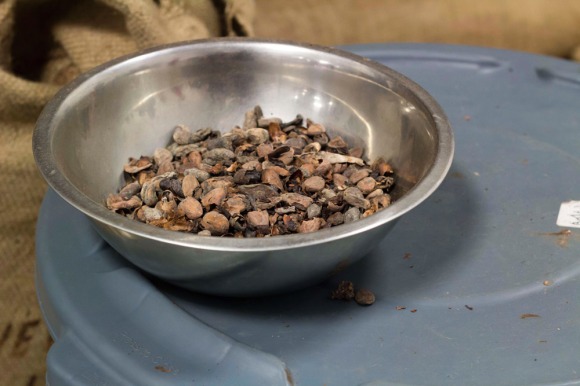
Dominican cacao beans

Soon enough, our tour-mates arrived. After a quick rundown on the difference between roasted and unroasted cacao beans, our guide led us to the bean room, where we’d soon learn more than we’d ever wanted to know about cacao. I can’t relate all that much information, because I got…um, lost in my thoughts (super-pressing questions like where are all the Oompa Loompas? and how many Willy Wonka jokes do these employees have to fake-laugh at per week?) but I swear our tour guide taught us a whole lot of stuff.

First, he taught us how to eat a cacao bean. Apparently, he’s spent a lot of time working farmers’ markets, where he’s met his fair share of that super-effete Whole Foods type who tend to just walk up to his stand, grab a cacao bean, say something to the effect of “mmm, antioxidants” or “ooh, a superfood,” and then pop the whole thing into his or her mouth, husk included. That, our guide warned, is not the way to go. Cacao husks are about as tasty as peanut shells—and after we’d been warned not to eat the beans whole, it was sampling time.

As we gathered around for our rations, our guide explained to us that cacao beans grown in different regions tend to pick up different flavors. He gave us each two nibs (a nib is a bean-chunk that’s had its husk removed), one from the Dominican Republic and one from…somewhere else, at which point we all realized that he wasn’t kidding. Though both beans were shockingly bitter, their flavors did have different undertones; one had distinct notes of earthy dirt, while the other was more of a dirty earth. (Sorry. They both tasted terrible to me. But they did have totally different flavors.) Nearly everyone made a sour face, and one of my tour-mates declared that he didn’t like chocolate—and then it was time to move on.

IMG_5282

Still in the bean room, our guide went on to explain the winnowing process (by which the beans’ nibs and husks are separated). Again, I had trouble focusing—why would you pay $10 to tour a chocolate factory if you don’t like chocolate, Red Shoes?—but the process involves three rounds of running cacao beans through a machine that removes and then sucks away their husks and only their husks. Neat.

The folks at Raaka used to have to spend all day removing husks by hand, so they were all rather thrilled when they were finally able to purchase a machine to do the job for them. They also recently picked up an optical sorter, which (I think) they use to make absolutely sure that there’s nothing but pure, unadulterated cacao nib going into their grinders—no husks, no rocks, no nothing—which is, of course, another job that used to call for human attention.

A vat of

After a long, long talk about husks and winnowing and optical sorting, we moved onto the the grinding room, where the nibs are ground (for three days!) into silky-smooth chocolate. That day, the Maple & Nibs vat was the furthest along, so that was the one we got to try.

At the prospect of getting to sample something sweet, our tour-mates finally started to look excited—and legitimately so, because that shit was good. Warm, smooth, and sweet, it was very dissimilar to the nibs we’d eaten in the previous room, and I was finally starting to have some fun. (Sugar. That’s all it takes, people. Also, dairy. But that one’s a lost cause at Raaka.)

After the chocolate comes out of the grinders, it’s still a little gritty, so it gets fed through a machine that looks a lot like a set of rolling pins for further smoothing. Then, it’s scraped into buckets and brought over to the tempering machine, which is in the factory’s main room.

IMG_5358

The tempering machine repeatedly heats and cools the chocolate to encourage it to crystallize properly, which makes sure the product comes out looking nice and shiny, gives it that satisfying chocolate-bar snap, and keeps the bars’ surfaces from going gray (for a while, at least). Then, after it’s tempered, the chocolate is poured into rectangular molds. If that day’s flavor calls for the addition of nibs or fruit or whatever, they’re added to the chocolate while it’s still wet, and then everything goes into a big ol’ fridge for half an hour or so to cool.

Raaka's labeling machine

Finally, the chocolate is wrapped and labeled. The wrapping machine, which is straight out of, like, City of Ember or something, can wrap around 400 bars per hour—way more than Raaka’s employees had been able to wrap by hand before they discovered this weird-ass machine in “the back of a warehouse in the Bronx.”

The labeling machine—way less steam-punk—applies labels (shocking!) to wrapped chocolate bars that glide by on a conveyor belt…and that’s it, really. That’s Raaka’s signature bean-to-bar process, of which they’re (understandably) rather proud.

(I know nothing and it’s showing—sorry. I’m here to talk about food allergies and share a few highly-compressed photos, not to pretend to be a chocolate expert. It wasn’t as if I was standing there taking notes, nor was I able to focus on nib-talk for long. I was hungry, and my thoughts were doing a lot of wandering. How many blocks do you think I’d have to walk to get a bottle of milk?, etc.)

IMG_5398

And then—then—it was chocolate-sampling time. While we’d been on our tour, the woman who’d welcome us had laid out five plates of samples for my tour-mates and me. On the menu that day was Bourbon Cask Aged (82% cacao), Maple & Nibs (75% cacao), Pink Sea Salt (71%), Piña Colada (60%), and Coconut Milk (60%). We sampled from darkest to lightest, as that’s apparently how it’s done, and each and every flavor was absolutely delightful.

The Bourbon Cask Aged was a little too dark for my 20-year-old, sugar-loving palate, but it wasn’t bad by any means. Maple & Nibs was refreshingly sweet, by contrast, and Pink Sea Salt was salty and satisfying, as expected. My favorites were the last two, though: Piña Colada was very sweet, with chewy bits of pineapple throughout, and Coconut Milk was creamy and soft. Perfect, really.

IMG_5401

After we’d all sampled each of the five flavors, the tour was over, and my tour-mates and I were set free…to the area with the rest of the samples. No one insisted we leave; no one pressured us to buy anything; no one sneered at us for taking too many little chocolate disks. We were under strict instructions to eat as much as we wanted—it was lunchtime, and our guide actually encouraged us to fill up on chocolate—and so we did.

Still, I couldn’t leave without making a purchase. I figured I’d go with the 3-bars-for-$15 deal—Piña Colada (my favorite), Raspberry Lemonade (of which there were no samples), and Sunflower Seed Butter (same deal as Raspberry Lemonade). But when I found out Piña Colada wouldn’t be for sale until the following month, I decided to just go with Sunflower Seed Butter ($8).

Anywho. I’m a shithead with the attention span (and palate!) of a toddler, but I had a wonderful time at Raaka’s factory (…when I wasn’t being shoved out of the way by one of my eldest tour-mates, that is). Our guide was super friendly, and he knew a hell of a lot about chocolate—and the folks at Raaka are very generous with their samples, which was a pleasant surprise.

In all, it was a great experience, and I’d recommend it to anyone who has even the slightest interest in chocolate. Plus, Raaka’s factory is a 15-minute walk from Carla Hall’s Southern Kitchen, which is totally nut-free, save for a packaged dessert or two. Make a day of it, if you’re into that sort of thing.

(Also, in the interest of accruing some bragging rights, I’d like to mention that I walked home—to Lower Manhattan—from Raaka’s factory. It was 90° and raining. I had boots, chocolate, and company, but I did not have an umbrella. Talk about making a day of things.)

Tagged , , , , ,

A Guide to Tree Nut–Free Peanuts and Peanut Butters

You can spend as much time as you’d like combing through Google results; you won’t find much in the way of information on tree nut–free peanut products. I’ve been complaining about this for a while (and I’ve blogged about it before, no doubt) but I figure it’s probably time to actually do something about the issue.

So…I have. I reached out to approximately half a billion peanut and peanut butter companies, and this post is the result. I’ve only included companies that are reasonably allergy-friendly, so if a brand’s not on this list, I’ve either never come across it or I’ve come across it and found that it’s probably not a viable option for those with nut allergies. (Or! A handful of stick-in-the-mud customer-service representatives have kept me from being able to find out much of anything about a company’s facilities. That happens a lot, actually.)

The products that have made this list are peanuts and peanut butters that probably won’t kill you…if you’re allergic to tree nuts and tree nuts alone, that is. And if you can’t eat peanuts (or if you’re in the mood for a change of pace), scroll down to the bottom of this guide for a section on other nut-free spreads.

(Looking for tree nuts free from cross contamination with other tree nuts?)

Continue reading

Tagged , , , , , , ,

Peanut Butter & Co.

A jar of White Chocolate Wonderful peanut butter

I spent last Friday on Roosevelt Island. Please don’t ask why; I really have no idea. Around the third hour, though, I ended up at Gristedes, the island’s only real supermarket. (There’s also a deli, a Duane Reade, and a natural market of sorts. For anything else, you have to travel.) None of this is relevant, of course—but Roosevelt Island is Twilight Zone–weird, so…I guess I wanted to mention where I was.

It was there, at that overpriced and poorly reviewed Gristedes, that I finally decided it was time to pick up a jar of this expensive-ass peanut butter.

I hated this stuff as a kid. I really did. I always thought it was gritty, bland, and generally unpleasant—though that didn’t quite stop me from trying every flavor I could find. I’m not sure whether it’s changed or I have, but…something‘s different, because I absolutely love this peanut butter.

A lot of tree nut–allergic people—especially those with a history of reacting to traces—express frustration with finding peanut butter made in a peanut-only facility. I usually eat Skippy (which, as far as I know, isn’t made in a peanut-only facility), but I know plenty of nut-allergic people for whom brands like Skippy aren’t an option, so I figured it was probably worth looking into some other companies.

One of the companies on my list was Peanut Butter & Co. Prior to my Roosevelt Island adventure, I’d sent them an email, and their reply was as follows:

Our peanut butter is manufactured in a facility that only processes peanuts. While many of our other products like jams, jellies, and peanut snacks may not contain tree nuts or seeds in the ingredient list, some are processed in facilities that also process tree nuts and seeds. Please check the label of the individual product you are inquiring about for more information.

Really, that was the answer I was looking for. But given how much I’d hated their peanut butter as a kid—and given that I’ve never seen a jar of it on sale for less than $5—it wasn’t as if I was ready to sprint to the supermarket and pick some up. It comes as no real surprise, then, that I had to be so hungry on such a strange island for this stuff to even begin to appeal to me.

Anyway…I bought some. I chose White Chocolate Wonderful, because white chocolate and I tend to get along pretty well. The jar cost $5.99, which made me sort of angry—but once I got my spoon (okay, finger) in there, all my anger dissolved. It wasn’t gritty or bland like I remembered; instead, it was smooth and flavorful—though not unpleasantly sweet, which I’d expected it to be.

Honestly, it’s really fucking good, and I feel a little bad for spending the last 10 years hating on this stuff. What’s done is done, though. I’ll guess I’ll have to right my wrong by overspending on Peanut Butter & Co.’s peanut butter till I’m sick of the stuff.

Find Peanut Butter & Co. everywhere: Gristedes, Whole Foods, Stop & Shop, Duane Reade, Food Emporium, Citerella…and a whole bunch of other places, too.

[Edit: After some further consideration, I’ve decided that Peanut Butter & Co.’s is probably my favorite all-purpose peanut butter. White Chocolate Wonderful, which tastes nothing like white chocolate, but rather which tastes like a standard sweetened peanut butter, is like an upgraded Skippy, and Dark Chocolate Dreams, which is ridiculously rich—like brownie batter, honestly—is perfect for finger-licking.]

Tagged , , , , , ,

Stern’s Bakery

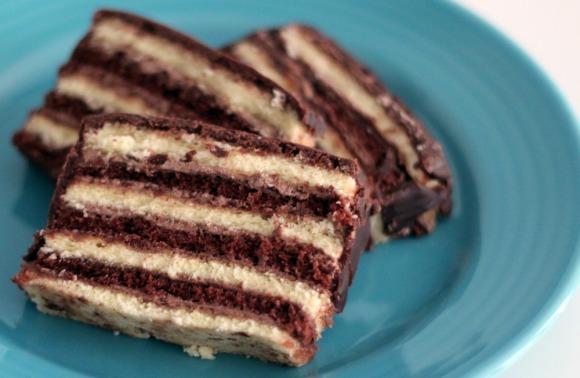
A few slices of a Stern's seven-layer cake

In the time I’ve spent on this blog, I’ve had a lot of luck finding nut-free kosher bakeries. For some reason, there’s a (relative) abundance of them in and around the city, so I wasn’t exactly surprised when I found out about Stern’s. There’s no such thing as too many when it comes to nut-free bakeries (or nut-free anythings, for that matter)—so of course, I had to give Stern’s a try.

There isn’t much information about Stern’s to be found online. Their factory, located in the very Orthodox neighborhood of Borough Park, is wholesale-only, but their Yelp page led me to believe they had a retail storefront, too. When I went, though, it was nowhere to be found, no matter how many people I asked for directions. Maybe I’m crazy, or maybe it doesn’t exist; either way, though, pretty much every market in the area had a wide array of Stern’s products, so I still managed to make it home with a sizable haul of baked goods—all with the words “made in a nut-free facility” on the packaging.

The first thing I tried (on my train ride home, of course) was a single-serving Confetti Brownie, which looks a whole lot like a Little Debbie’s Cosmic Brownie. At first bite, I didn’t really like it—it was too sweet, and the chocolate tasted too artificial—but the texture won me over, and by the end, I was wishing I had more. The chocolate danish, though, was worlds better. It was moist and thick, with plenty of far-less-artificial-tasting chocolate, and I thoroughly enjoyed it.

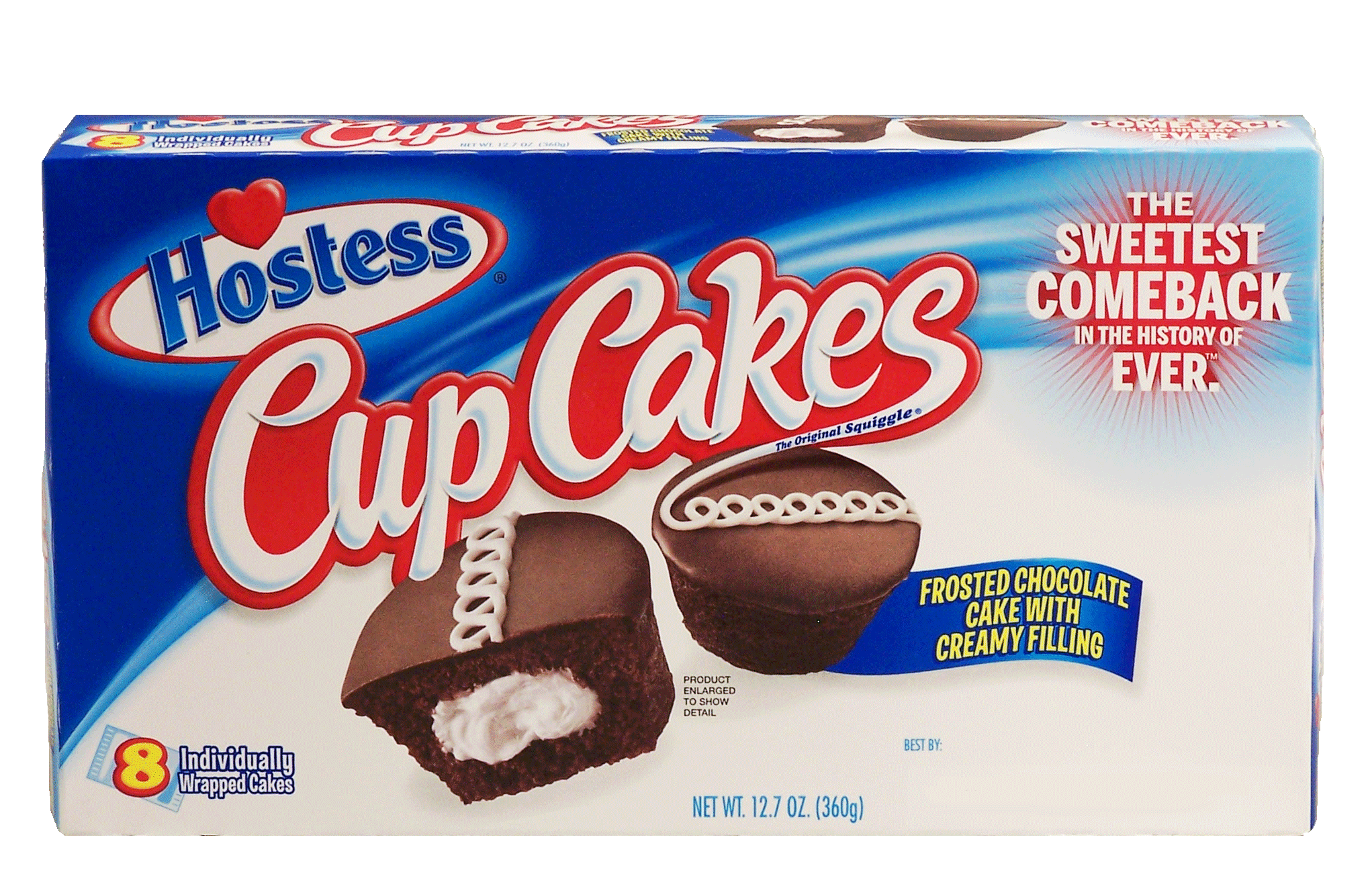
Finally: the black and white seven layer cake (pictured above). Somehow, I actually managed to wait until I got home before digging into this one. Honestly, though, it wasn’t very good. It smelled exactly like a Hostess CupCake, and it didn’t taste much better. It was far too sweet, though I think there’s a good chance the regular seven layer cake would have been better, as it doesn’t seem to have as many layers of frosting (or whatever that stuff is—I’m not sure).

Still, Stern’s is a solid option for (nut-free!) packaged baked goods. Their products are better (and probably safer) than anything made by Hostess, Drake’s, or Little Debbie—and though I like Green’s better, Stern’s is certainly a company I’m willing to throw my very inconsequential weight behind.

Tagged , , , , , ,

Gerbs Allergen Friendly Foods

Gerbs

I’ll just come right out and say it: Gerbs is a pretty awesome company. Everything they sell is entirely free from the top 8 allergens (plus sesame and mustard, too). It’s all vegan, kosher, and non-GMO, and it’s all free from sulphur dioxide, potassium sorbate, sodium benzoate, nitrates/nitrites, MSG, and trans fats. Truthfully, I couldn’t possibly care less about any of that—but I do care a whole lot about nut-free seeds, granolas, and dried fruits. As many people seem to be incapable of understanding, seeds are not nuts; they’re seeds, and I can eat them, as can everyone else who’s (just) allergic to nuts. Often, though, seeds come cross-contaminated—especially if they’re shelled—so it can be a real pain to find safe ones.

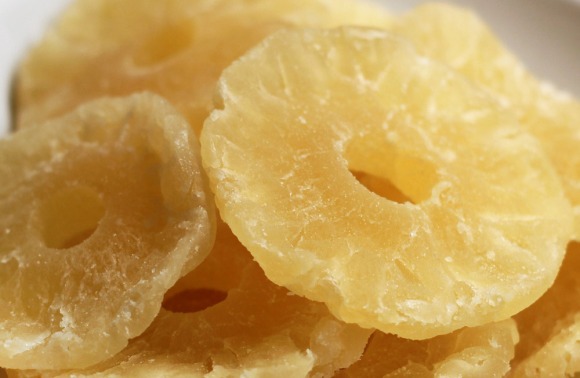
The same goes for dried fruits. For some reason, they’re almost always made by companies that handle lots of nuts. I tend to really like dried fruits, though, so I’ve been searching—really, really searching—for a safe and reliable source for a while now. Trader Joe’s has some options that work for me, sure…but they don’t have my personal favorite: pineapple rings (the sweetened kind, because I am a child).

Enter Gerbs, the solution to all (well, some) of my problems.

gerbs2

Gerbs carries chocolate products, coffee beans, dried fruits, seeds, grains, granolas, rice, oats, and various snack mixes, all free from the junk (and allergens) mentioned above—so basically, they sell a whole bunch of stuff that’s tough to find. And though their products aren’t available in stores, they are available online, and at (somewhat) reasonable prices, too. [That first link is to Amazon, where a whole bunch of Gerbs products are Prime-eligible. Game-changing, really, for those of us who straight-up refuse to (a) order in bulk or (b) pay for shipping.]

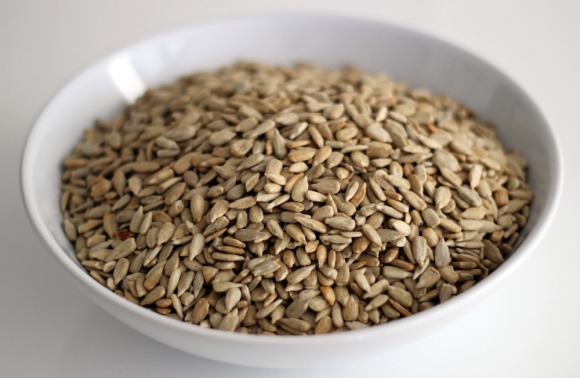
It wasn’t until last week that I finally got around to ordering some of this stuff. I got a pound of lightly salted sunflower kernels ($3.99), and—of course—a pound of sweetened pineapple slices ($7.99). And since my order only weighed 2 lbs, I only had to pay $5.99 for shipping, which would’ve otherwise gone up to $12.99. (Only. As if. Obviously, I placed this order before finding out about the whole Gerbs-is-Prime-eligible thing. Live and learn, I guess.)

To my surprise, the box arrived within two days—and fortunately, I have very little to say, other than that products I received were perfectly fine. The sunflower kernels taste like sunflower kernels—though I’m not sure I’d have labeled them as lightly salted—and the pineapple rings are just what I’ve been wanting. My only (cliché) complaint is that they disappeared far too quickly. I think I’m good on sunflower seeds for a while, though. Apparently, a pound is quite a few servings. (Just in: My eyes are way bigger than my stomach. Who knew? Guess I have some sunflower-seed pesto in my near future.)

Anyway, Gerbs is most definitely a company worth supporting—and their products are definitely worth eating, too. Find them, as I’ve said, on both Amazon (Prime!) and the Gerbs website.

Tagged , , , , , ,

Fruit Slices

SweetGourmet fruit slices

I used to eat these jelly-based fruit slices all the time as a kid. Who knew they’d be so hard to come by for those who can’t eat nuts? Lots of supermarkets buy them in bulk and repackage them for sale—but they do the same with nuts, so more often than not, the fruit slices you’ll find at Fairway et al. come with “may contain” warnings. Shame. But I’ve really been craving these, so I had to make it happen.

Now, SweetGourmet definitely sells nuts; in fact, they have a whole category on their site devoted to nuts and seeds. But fruit slices aren’t all that easy to find, and I was pretty desperate to get my hands on some—and (for some reason!) I didn’t want to order them from nuts.com, so I decided to give these a try. Their ingredients are as follows:

Sugar, glucose, agar, citric acid, cottonseed oil, egg albumen, natural and artificial flavors, artificial colors (red 40, blue 1, yellow 5 & 6). **Contains: Egg Ingredients. Product information/materials may change.

Not the ideal company for someone with a nut allergy, but hey, fruit slices. So far, I’m around 75% of the way through my box, and I’ve had no issues. I got them off of Amazon, but they’re available straight from SweetGourmet, too. I ordered the middle size (20 oz.), and they arrived within a few days, packaged in a large box with sheets of wax paper separating the layers of fruit slices.

Anyway, they’re pretty good, if you’re into fruit slices (is anybody?). My only complaint is that the assortment is a little lacking. (I’m told it’s very inconsistent and varies a lot by box.) My box had mostly greens, reds, oranges, and yellows—which is unfortunate, because the watermelons and the blue raspberries are the real stars.

Tagged , , , , ,

See’s Lollypops

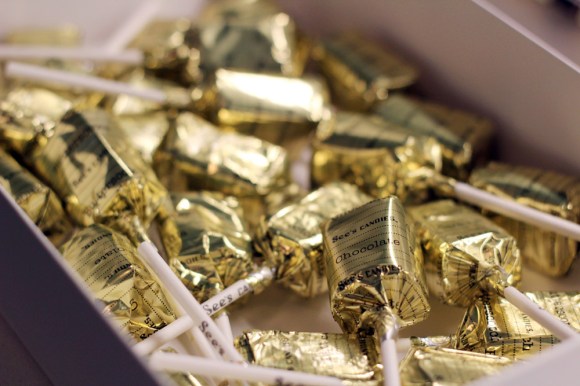
A box of See's Lollypops

I used to eat See’s lollipops (I’m sorry—I’m not going to use their spelling) on occasion as a kid, but I had no idea they were nut-free until a random flashback sent me Googling. See’s makes lots of nut products; who would’ve expected them to make these (gourmet!) lollipops in a nut-free facility?

On their website, there’s an allergen information page with lists of the See’s products that are free from from nuts, dairy, gluten, soy, and egg. There’s also a nut-free filter, and their FAQ states that candies marked nut-free are those that “are free of nuts and have been manufactured in a nut-free facility.” So at See’s, nut-free really seems to mean nut-free. Miraculous.

The lollipops are expensive ($18.50 for a box of 30) but truthfully, they’re worth it. Flavor-wise, they’re unlike any other lollipop I’ve ever had—rich, creamy, and never too sweet—and they last for-goddamn-ever, too (both individually and as a box), which makes me feel a little better about the price.

The assortment comes with four flavors: chocolate, vanilla, butterscotch, and café latte. They’re all made with butter and heavy cream, and they’re all delicious in their own way, but my personal favorite is the butterscotch (which is the sweetest by far—go figure). It’s super buttery, but not at all in a sickening way. It’s actually pretty salty, too—so in all, it’s perfectly balanced.

Chocolate’s probably my second favorite. The flavor’s closer to cocoa powder than, say, pudding, which took me some time to get used to, but once I got there, I was sold. It tastes a lot like a brownie—not the Betty Crocker kind, but a good one. (An adult brownie, I guess.) It’s very rich, and it has a sort of grainy texture, which I like. And for a lollipop, it’s actually sort of filling.

Vanilla and café latte are my least favorites, but they’re not bad by any stretch of the imagination. Vanilla’s very creamy, which is nice—and it gets a little chewy around halfway through, which is strange, but inoffensive. Café latte is great, I’m sure, if you’re into coffee, but I’m not, so I could probably go without this one. It’s all right—somewhat bitter, and subtly sweet, too—but again: I’m not into that strong coffee flavor. Oh well.

Clearly, though, I’m into these lollipops. I found them at Macy’s in Herald Square (6th floor—you’re welcome), and they’re apparently sold at Lord & Taylor, too. Or, if that’s too much trouble, they’re available online. In any case, they’re certainly worth a try—even if you aren’t a fan of lollipops.

Tagged , , , , , ,